

Designs made by our campers!
During the recent December holidays, we organised a unique coding camp — one that had a distinctly different flavour from our regular camps. Compared to those, this camp was a hybrid of coding and sewing.
WHY CODING AND SEWING?
We chose coding and sewing because of our friends at Bernina, the world’s leading sewing machine manufacturers. At the time, both of us were planning to hold a holiday camp, hence, it seemed fitting for us to collaborate. As the saying goes, “the whole is greater than the sum of its parts,” perhaps there were synergistic benefits to be gained from merging coding and sewing together in a single camp!
THE CAMP TURNOUT
This wasn’t the first time we partnered with our friends at Bernina. In June, we ran a similar Sew and Code camp and realised there were many kids interested in such a fusion of skills. Hence, during this winter break, we organised multiple runs of this 4-day camp.
Organised for kids, our campers were aged between 9 to 12 years old. Although most of them had done some coding in their school, none of them had ever touched a sewing machine before. However, all of that was going to change over the next few days.
DAY 01
We kick-started our camp with some friendly introductions and ice-breakers. It wasn’t easy getting 20 elementary school campers to talk with one another especially since most of them were introverts.
However, by the end of the first hour, our campers began loosening up and feeling more at ease, signalling that we could proceed to our first segment — sewing with the Bernina 535.
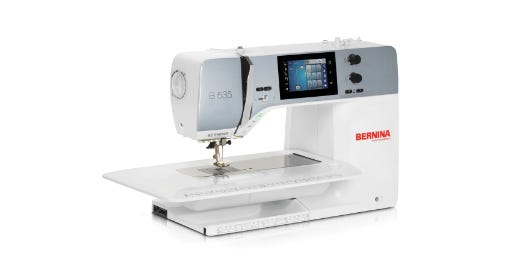
An image of the Bernina 535
For those unfamiliar with the Bernina 535, it is an unbelievably simplistic sewing machine that allows both beginners and professionals to quickly produce stellar and stunning stitched fabrics.
One by one, each pair of campers was assigned a Bernina 535 to use. Hours flew by like minutes as our campers grasped the basics of using the machine, such as how to place a spool of thread into the machine, how to select the type of stitch they’d like, and finally how to operate the machine and foot pedal simultaneously.
With over 1,000 stitches to choose from, our campers were spoilt for choice. “I’m going to try all the stitches,” Stephen, a 12-year-old camper, announced. His sentiments were matched by many of the other campers too.
Whether they were girls or boys, it didn’t seem to matter. Over the next hour, all our campers were wholly engrossed in stitching. The process of deciding a stitch, using their hands to manoeuvre their fabrics and their feet to power the machine got them involved so deeply that it seemed even their smartphones couldn’t break their intense concentration!
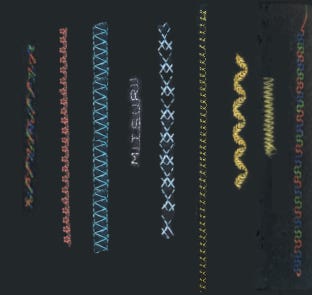
Some stitches completed by our students using the Bernina-535
After completing multiple stitches, our campers began working on their project for the day: making designer pouches! They sketched their ideas on paper before obtaining the required materials such as felt fabric, thread, stabilisers and scissors. After stitching their designs onto the stabiliser, they then stitched them onto their chosen felt fabrics. Unsurprisingly, the older kids were done with their pouches lickety-split and used their free time to further polish up their pouches. Judging from their wide grins, it was certain that they were proud of their marvellous creations! Meanwhile, our younger campers took the time and managed to complete their pouches with exceptional finesse.
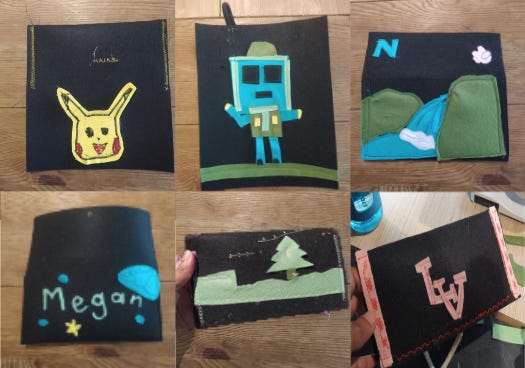
Take a look at the pouches that our campers made!
DAY 02
After the delightful experience they had the day before, our campers arrived on day 2 bubbling with excitement for the activities that lay ahead. While the previous day mostly involved sewing different fabrics together, day 2 focused on embroidery (i.e. stitching for visual appeal rather than practical purposes).
Since embroidery entails stitching intricate and geometrically perfect designs, it requires much more precision and accuracy compared to regular sewing. As such, to avoid having human error introduced into our embroidery, we turned to Turtlestitch — a block-based programming platform used by sewists to create elaborate patterns that remain exactly proportional no matter how many times you scale it up or down, or repeat it.
Although on the surface, Turtlestitch, with its colourful coding blocks, and visual output seemed simple enough for our budding coders to comprehend, the process of creating ornate designs using code (loops, variables) and mathematics (i.e. angle rotation and distance) proved to be exacting for our campers.
Thus, to smoothen the steep learning curve, we explored each concept in detail and offered our campers little hands-on exercises to test out these concepts for themselves. Through this experiential approach, our campers’ knowledge and confidence grew.
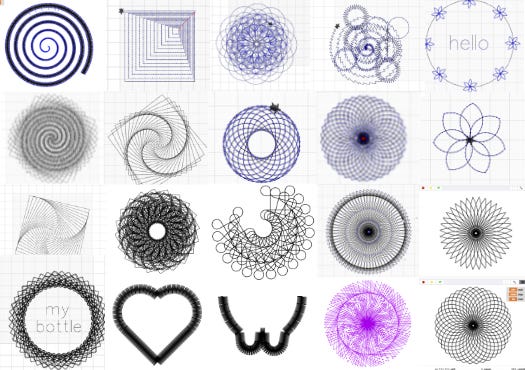
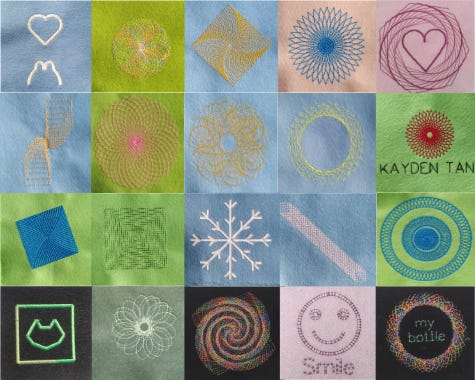
Beginning with the simplest of shapes, the square, our campers slowly progressed to coding more complex shapes like the ones below!
Designs made by our campers on Turtlestitch!
With their designs completed and ready to be embroidered, the Bernina 535 machines got to work. The speedy machine churned out a total of 20 embroidered fabrics at record speed. Lo and behold, our campers’ masterpieces:
DAY 03
After two consecutive days of sewing, it was at last time for coding! With a box full of micro:bits, LEDs, crocodile wires and many more, we began our demonstration of the various micro:bit features.
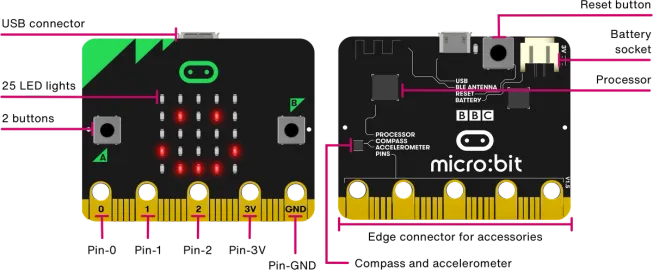
From the in-built speaker, to the LED lights and the 2 buttons, we covered all of the micro:bit’s most essential features. To top that off, our campers also worked on mini micro:bit coding exercises to apply the knowledge they learnt.
They made LED icons display on the micro:bit and used the A and B buttons to change the icon displayed. Subsequently, they also braved through a rigorous coding challenge — building an electronic piano. This challenge stretched them as they learnt about functions, touch sensors, lists and conditional statements. Despite a chock-full of surprises and frustrations, our happy campers persisted till the very end.
Having learnt so much coding in a day, our campers’ definitely deserved a break. So, we broke off for a short but refreshing break. Munching on chocolate buns, lemon biscuits, and bananas, our campers recharged themselves just in time for the project of the day — making a micro:bit-powered LED sign board!
Once again, they started with a simple sketch of their sign board design. After which, they proceeded to sculpt optic fibres on a fabric. Despite the initial groans and grievances, and comments like, “This is testing my patience,” the optic fibres were unequivocally ready for the last step: coding.
20 micro:bits and the relevant LED modules were brought out from their boxes once more. Soon, the necessary codes were written and the optic fibres were connected to the micro:bit and LEDs. The LED sign boards were done!
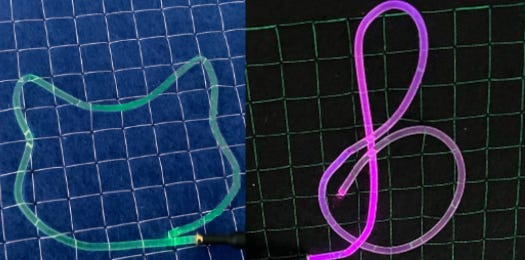
Examples of the sign boards that our campers created!
“That was so much fun! I got to make my own design and it looked really pretty!” Xintong, an 11-year-old camper, shared with us. Scanning the room, it was clear many of the others enjoyed themselves just as much too.
DAY 04
On the final day of our camp, we dove right back into the micro:bit and its capabilities. Our campers discovered the similarities between walkie talkies and micro:bits and how radio waves are used to send information from one micro:bit to another.
Apart from the radio function, campers also experimented with the in-built accelerometer to determine a micro:bit’s movement in different directions. Equipped with this knowledge, they coded a digital dice, and DIY walkie talkies using micro:bits.
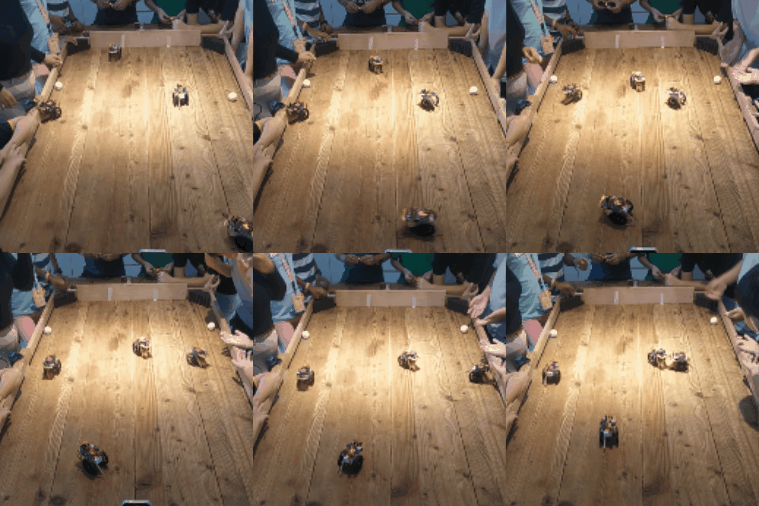
To test our student’s retention of their newfound knowledge, we announced their final project — building a remote-controlled micro:bit robot. To spice things up, we informed them that their bots would be battling each other in a football match at the end of the day.
Without a moment’s delay, each team of campers took a stab at building their micro:bit robots and remote controls using two micro:bits and many other component parts. As they had already learnt all of the coding concepts before, it didn’t take too long for them to figure out how to build their bots and remote controls. Regardless, we offered our help whenever they got stuck.
In the end, each of our teams finished their robots to perfection and managed to build remote controls to navigate their robots around their tables. Hence, the football battle commenced! Check out their robots in action below:
FINAL TAKEAWAYS
Reflecting back, we’re glad to see that this camp won over the hearts of so many of our campers. Apart from allowing them to express themselves creatively, this camp offered kids the opportunity to see coding in a new light. Most importantly, it gave them the opportunity to have fun while coding and sewing and that’s what made all the difference.
JOIN OUR CAMP!
If the experiencing of merging the tactile joy of sewing with the boundless creativity of coding intrigues you, the Sew and Code camp beckons you. The Bernina 535 awaits, and the micro:bits stand ready to transform your incredible ideas into reality. What are you waiting for? Drop us an email at hello@tk.sg, and we’ll be glad to share more!