


As the world becomes increasingly dependent on technology, the need for a workforce proficient in an environment augmented with artificial intelligence (AI) is growing at an unprecedented rate. According to the World Economic Forum (WEF), AI and other advanced technologies will create 97 million jobs across 26 countries by 2025. The ability to understand and utilise AI is now no longer a luxury, but a necessity for anyone looking to stay competitive in the job market. So, how do we teach AI to the next generation of business and industry leaders?
Teachable Machine
Teachable Machine, a brainchild of Google Creative Lab, is one of our favourite tools we use to teach AI. Designed to make AI models less intimidating to build, Teachable Machine has achieved astounding success with over thousands of users across the globe.
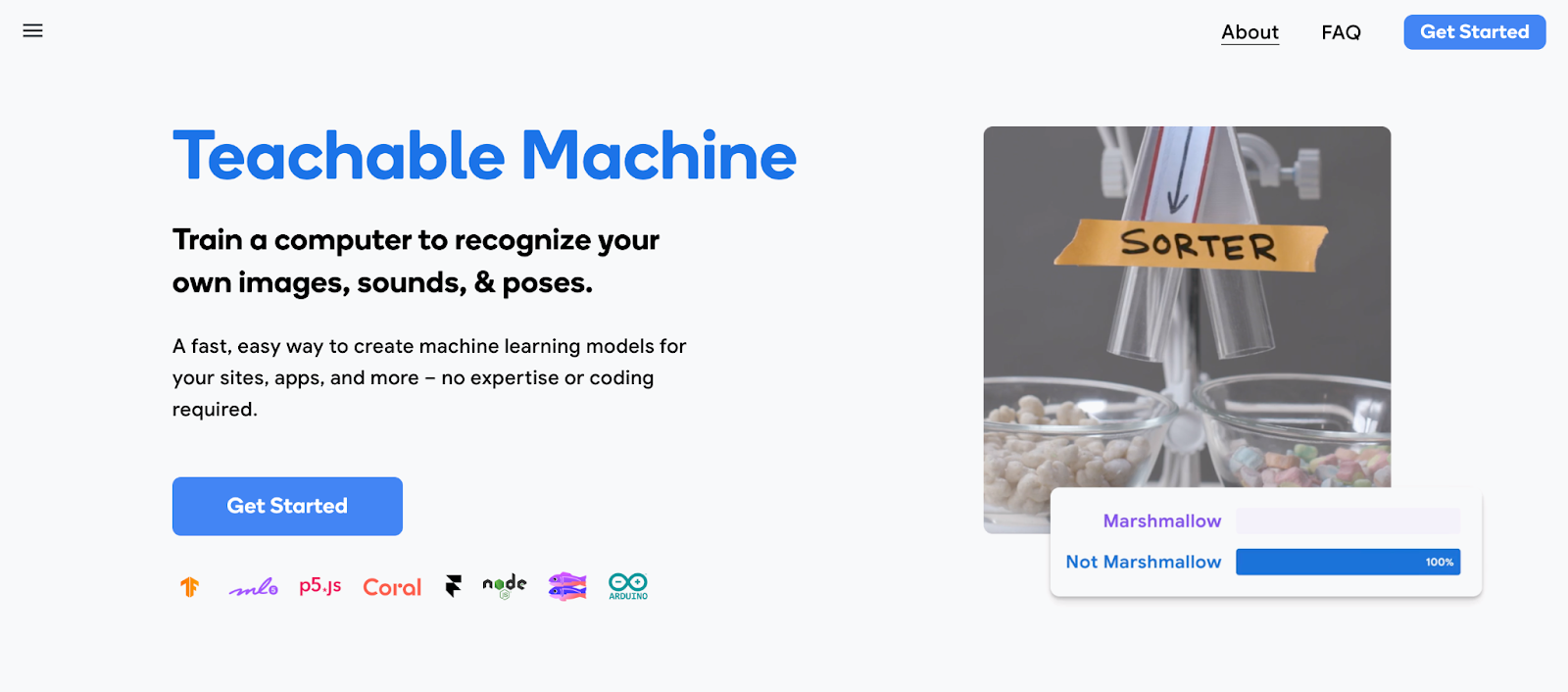
A screenshot of the Teachable Machine website
As technology educators, we’ve found Teachable Machine to be effective in bringing the basics of AI to those with no prior background in programming. Its huge appeal stems from the fact that it requires zero coding!
To create an AI on Teachable Machine, users first provide training data in the form of images or audio files. Next, they label these data, categorising them into 2 or more groups — creating their training data set. And finally, with a single button click, Teachable Machine takes over to train and build a fully-functional AI model.
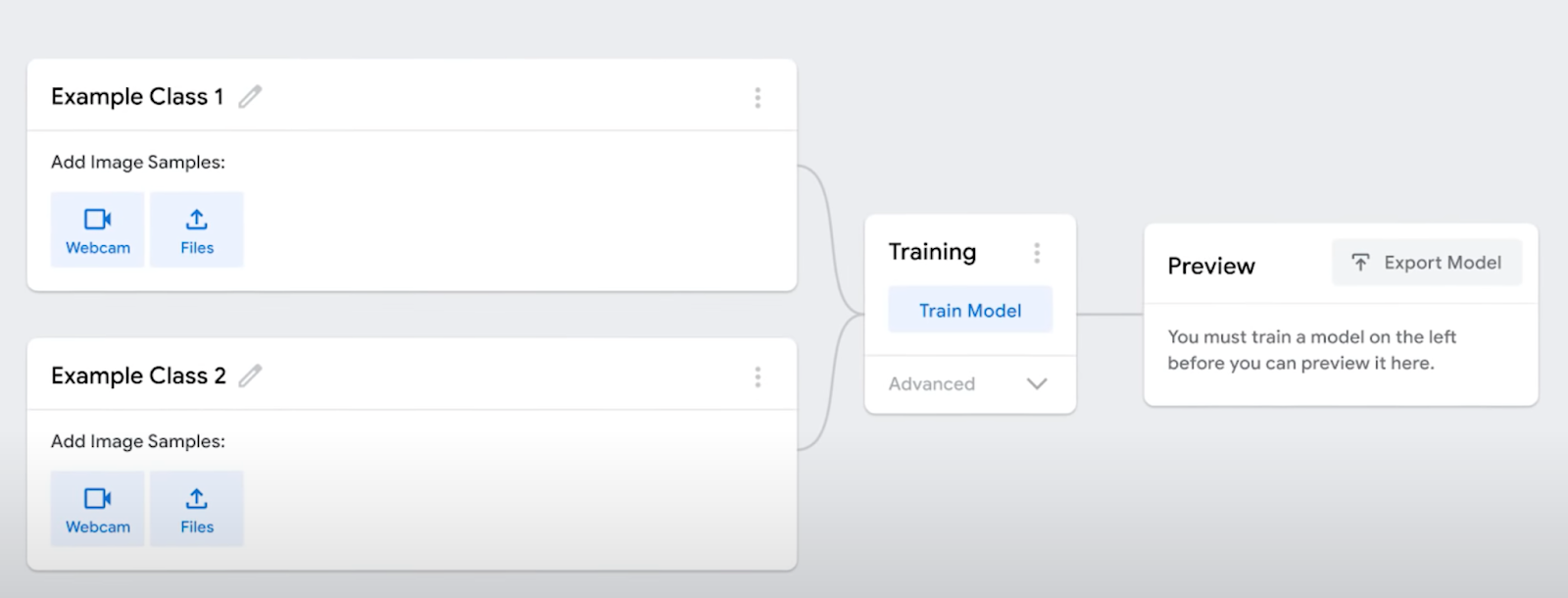
Teachable Machine guides users through making an AI. (Credits: Teachable Machine)
Unlike in the past, when building AI used to be tremendously difficult wherein you’d first need to take modules in programming and machine learning before you could train an AI, today, Teachable Machine offers everyone the opportunity to build the same kinds of AIs in minutes.
Granted, learners no longer grapple with statistical algorithms or coding syntax, nor do they get the thrill of building an AI from scratch. However, despite these trade-offs, we feel that the act of creating an AI on the platform nonetheless provides valuable takeaways for AI beginners.
For instance, whenever we use Teachable Machine in our classrooms, our learners are quick to recognise the crucial role that data plays in the making of robust AIs. Through experimentation, learners discover that the higher the quantity and variety of training data supplied to an AI, the better it becomes at recognising objects and distinguishing sounds.
This exposes a major challenge for AI developers: How do we get more data to improve our AI’s performance? As we explore various case studies like the 2016 Facebook-Cambridge Analytica scandal, learners realise that recklessly gathering vast amounts of data could border the lines of privacy infringements and understand the necessity of keeping their AI models free of such ethical misconduct.
Teaching AI via Teachable Machine thereby not only exposes learners to fundamental machine learning problems such as bias in data, and ethical considerations like data privacy but also offers them the chance to brainstorm and solve these problems independently by building their own AIs.
Machine Learning for Kids
Besides Teachable Machine, another tool we regularly use is Machine Learning for Kids (ML4K). Similar to the former, the workflow for training an AI on ML4K is just as intuitive, where users upload an assortment of training data and click a button to obtain a powerful AI.
But with ML4K, users can import their projects into Scratch or Python to create an interactive user interface as well. For instance, instead of building an AI that can recognise the emotion of a person based on text input, users could code a Scratch project that displays either a smiley face or sad emoji whenever a text is entered on the screen. Of course, this is just an example; users can customise their projects according to their preferences.
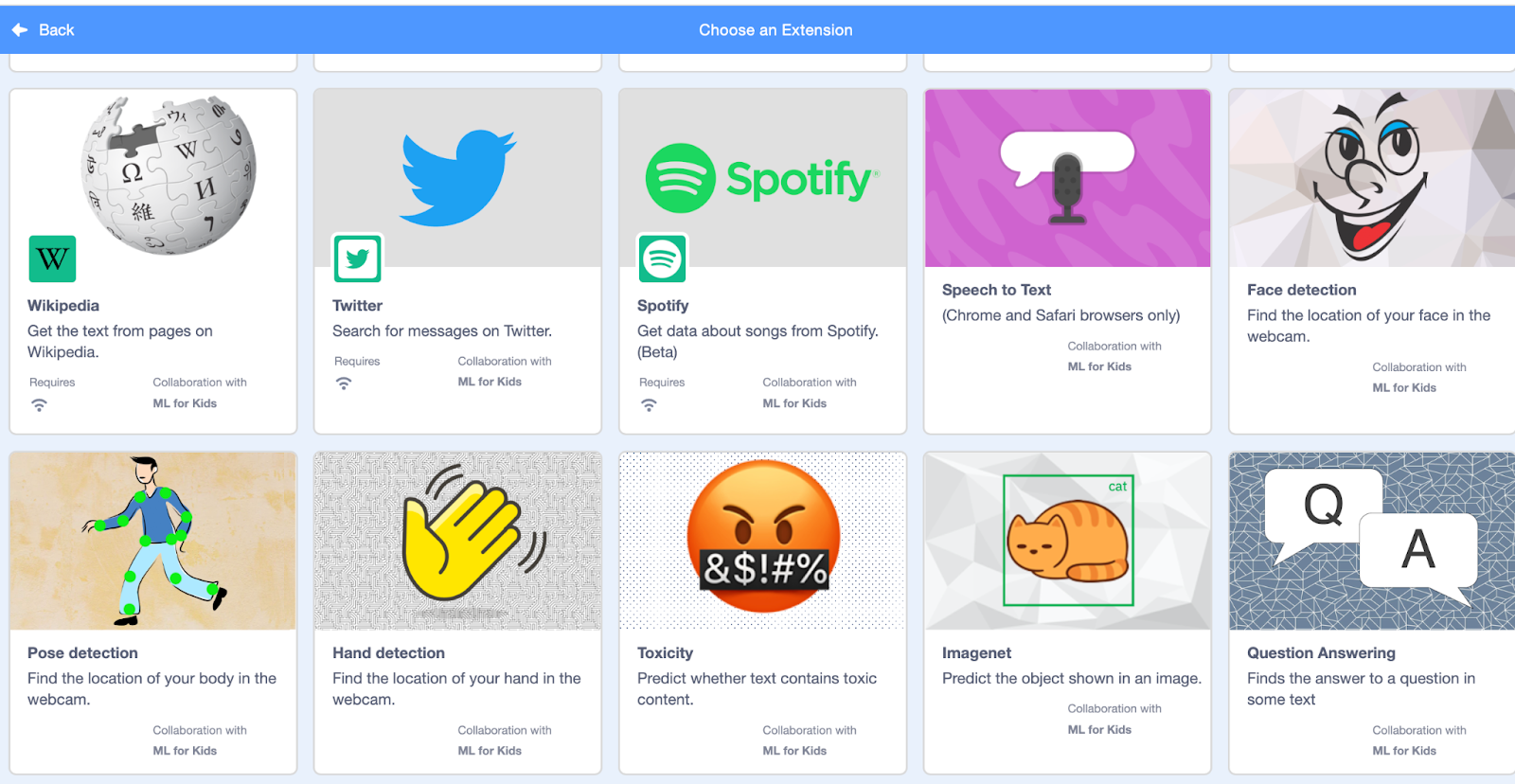
A couple of possible ML4K AI projects that can be coded on Scratch.
Admittedly, the colour-coded block-based environment of Scratch tends to put off many teenagers and adult learners as they feel that the platform is meant only for young kids. But, when given a chance, Scratch proves itself to be a very powerful environment, and for non-programmers of all ages, it gives them the power of creation at their fingertips.
Many of our lessons guide learners through ML4K’s AI models and a supplementary hands-on Scratch coding project. By fully immersing themselves in the start-to-end stages of AI development, learners gain a more holistic appreciation of AI.
While they might’ve taken AI for granted before, upon completion of our ML4K lessons, they return to their daily lives with a broader perspective. After all, the end result of AI is not the AI Model, but how we use AI in new and interesting applications. The ability of the sentiment analyser mentioned above isn’t particularly spectacular until it’s applied by businesses to respond effectively to customer feedback. That’s a huge takeaway we aim to impart to our learners.
Python ML Frameworks
Lastly, we use Python ML frameworks like TensorFlow and Pytorch to further delve into the field of AI. For these lessons, since there’s some coding involved, they’re recommended for learners who’ve had prior coding experience.
Both TensorFlow and Pytorch are popular open-source Python libraries for machine learning and deep learning. As such, these frameworks provide students with a high-level, user-friendly interface for building and training neural networks. These frameworks abstract away the low-level details of implementing a neural network from scratch and focus learners’ attention on understanding the core concepts of building their own AI models.
By eliminating the tedious and irrelevant details, these frameworks offer a rich learning experience for learners to explore the structure of neural networks in a deeper way. For instance, learners may experiment with a variety of different neural network architectures and through this process understand first-hand how they work.
Additionally, these frameworks come equipped with multiple datasets that are easily accessible via pre-built models and functions. Learners can use these large datasets to flawlessly train their AI models and get started building highly-reliable AIs.
In our classrooms, we often make use of Fashion-MNIST, a dataset containing up to 70,000 images of clothing items, such as shoes, shirts, and pants. Commonly used as a beginner-friendly introduction to image classification, this dataset has empowered many of our learners to train their own image classifiers and experiment with different model architectures and hyperparameters.
Ultimately, we believe that by teaching AI through these Python ML frameworks, we’ll be able to demystify the technology that powers AI, and thereby make it less intimidating for AI beginners as they realise that AI isn’t magic, but a bunch of math. And that they too can develop powerful AIs with some practice.
Want to Learn AI?
The tools and resources available to teach AI are constantly evolving, but one thing is clear: there is no better time than the present to start learning about AI. Whether you’re an educator looking to introduce your students to AI, a parent wanting to give your child a head start in the field, or a professional looking to stay competitive, we’re here to provide the guidance and expertise you need. Reach out to us at hello@tk.sg if you’re interested to learn more about our latest AI programmes.