

Coding without Computers — The Untold Power of CS Unplugged

Most of us conflate computer science (CS) and computers as a single unified concept. We cannot imagine learning computer science concepts without a computer. It’s like learning about chemistry without mixing chemicals in the laboratory. But of course, there is more to chemistry than understanding what happens when chemical A is mixed with chemical B. Chemists learn about the structure of the atom without ever being able to see one, and physicists study wormholes, even though no one has ever discovered one. Similarly, there is a lot of CS knowledge that doesn’t need hands-on time with a computer, and a lot of this knowledge is interesting and instructive in many different fields. The CS Unplugged project exists precisely to address the knowledge we would otherwise overlook while being distracted by a computer.
Though currently, the term CS Unplugged is used in several slightly different ways, the term was originally coined in the 1990s when three computer science researchers, Tim Bell, Ian Witten and Mike Fellows first shared a collection of activities online intended for academics involved in computer science outreach.
The story goes that Bell, Witten and Fellows recognised that computer science had many great ideas to offer young students and all of these could be made easily accessible to students as young as 7 years old without ever needing them to learn to program — or touch a computer!
They, thus, developed offline activities that allowed young students to dive head-first into Computer Science. Although these were initially intended as enrichment resources, the CS Unplugged curriculum has since found its way into many classrooms worldwide — Sweden, Germany, Japan, and Korea just to name a few.
Curious to discover what CS Unplugged looks like in practice? Read on to see how we brought two exciting CS Unplugged activities to the public so they can experience for themselves the wonderful world of computer science.
Challenge
Months back, Singapore Digital Office (SDO) informed us of their interest in getting us to join them in their upcoming Celebrate Digital @ Kreta Ayer-Kim Seng event. As a fellow Digital for Life partner, we were asked to organise some games and activities to make digital learning fun for Singaporeans, regardless of their age, gender or abilities.

Singapore Digital Office Logo (Credits: SDO)
We were thrilled to be part of the event. It offered us the perfect opportunity to reach out to the public and showcase the exhilarating joy of technology. All that was left was for us to decide on the right activities and games that would appeal to our diverse crowd.
Solution
CS Unplugged!
Right off the bat, we knew that CS Unplugged activities would make an excellent choice since it was famous for its simplistic, hands-on and enriching activities that were appropriate for any audience.

CS Unplugged Logo (Credits: CS Unplugged)
Graph Colouring
After browsing the many CS Unplugged activities online, we finally chose Graph colouring. Here is where you might ask, “How does colouring a map have anything to do with Computer Science?”
Of course, colouring a map sounds like an easy task but the problem of finding the minimum number of colours to be used isn’t a trivial one. In fact, it took exhaustive proof to show that every map can be coloured using a maximum of four colours.
Ultimately, this activity teaches a particular set of problems and the algorithms that are used to solve them. While it may apply specifically to maps, the idea extends much further into real-life problems like scheduling timetables as well — and doubles as a creative yet challenging puzzle suited for anyone.

A man colouring a map (Credits: CS Unplugged)
Fun with Ozobot
Another activity we chose involved the Ozobot. In case you were wondering, the Ozobot is a miniature robot that can be programmed completely screen-free using colour codes. Say you wanted the Ozobot to move slower, all you need is to add the colour red to its path using a handy red marker. And that’s what makes it fun — because you can turn colours into a program!
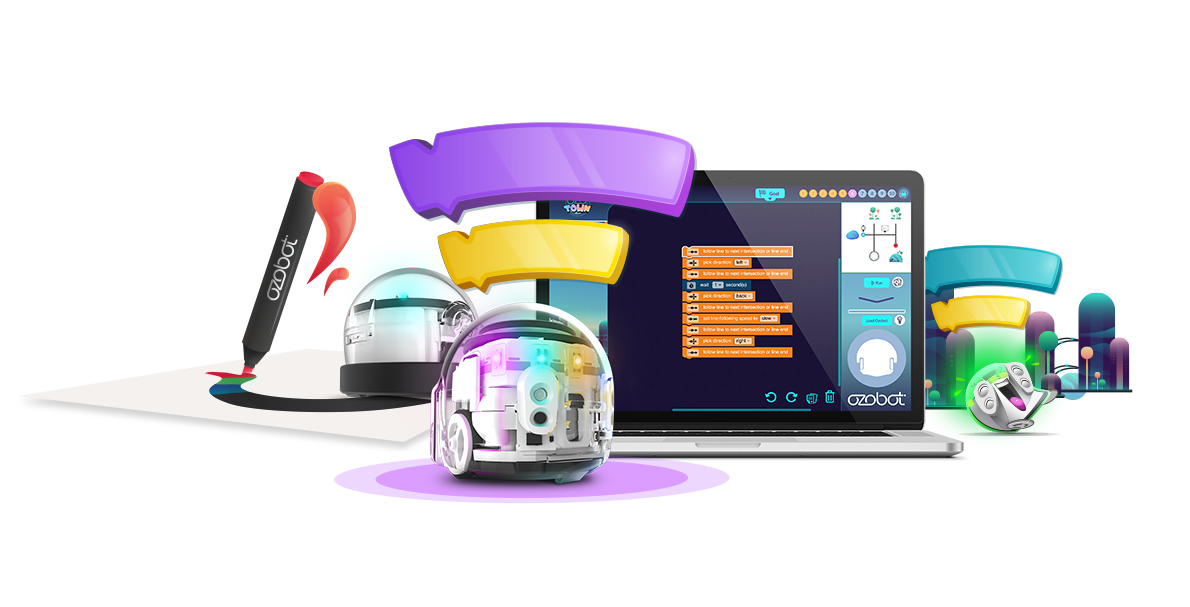
Credits: Ozobot
Outcomes
On the day of the event, we were pleasantly surprised to see many Singaporeans, young and old gathering around our booth to try out both the Graph colouring and Ozobot activities. We could tell that despite having no background in Computer Science, all of them were nevertheless able to explore their curiosity about robotics and algorithms in one way or another!
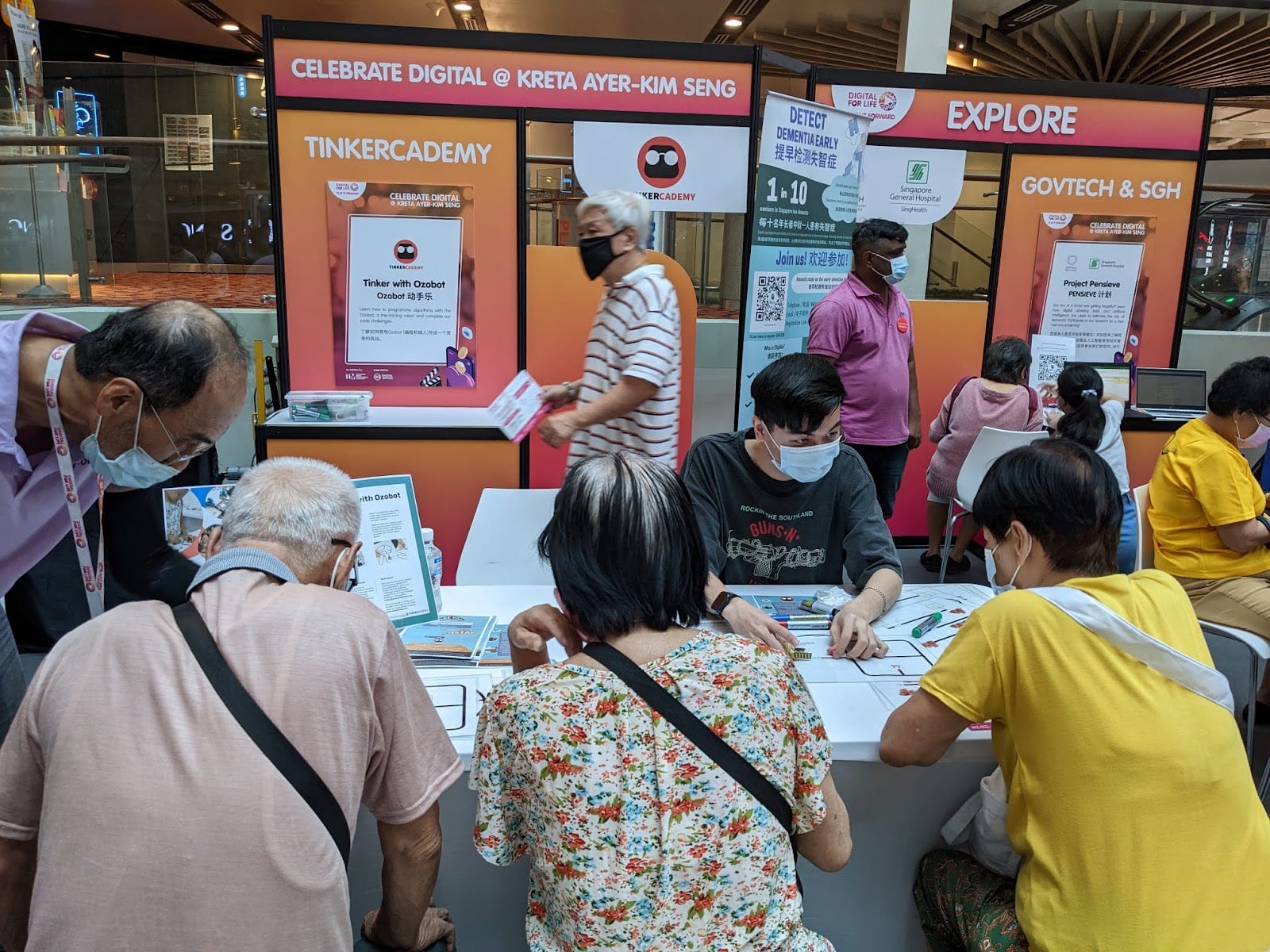
Singaporeans of all ages trying out our CS Unplugged activities!