

An entry from Nadya, now at the National University of Singapore, who interned with us a couple of years ago, detailing her foray into creating a lesson around a Circuit Scribe pen. Sorry we took so long to publish this, and thanks Nadya!
Many of the activities built, constructed, and written about at Tinkertanker/ Tinkercademy are physical toys and projects — documentations of us playing around. But what you’d see less of (which happens just as much) on this Build Log would be the behind-the-scenes of curriculum planning. Perhaps because the team is busy doing PowerPoint slides… and making slides isn’t that interesting to document.
Tinkercademy caters to a wide age range of students, with toys and curriculum aimed at students from preschool all the way to secondary school. Some of these activities and projects published online on social media or our Get Hacking website are fun extensions based on our products and courses offered. But how does one go about designing these things?
My project was targeting younger children, with the aim to incorporate our Circuit Scribe sets. The Circuit Scribe pen is a special pen with conductive ink that enables kids to draw out working circuits without the use of any other wires. The Circuit Scribe Basic Kit comes with some basic circuit components, such as LEDs and a switch.
Learning objectives
To come up with a suitable extension activity for the set, I had to know what exactly I thought kids could get out of the learning experience. Science concepts? Art concepts? A taste of both?
After reading through the accompanying booklet in the Basic Kit, I realised that it presented the basics of electric circuits through a scientific perspective. To complement this, I decided that approaching similar concepts from an artistic point of view would allow the Basic Kit to appeal to a larger audience, including kids who were more artistically inclined.
Hence, I decided on some learning objectives that included both science concepts of circuit basics and electrical conductivity of materials, as well as introducing art and design concepts.
Designing the activities
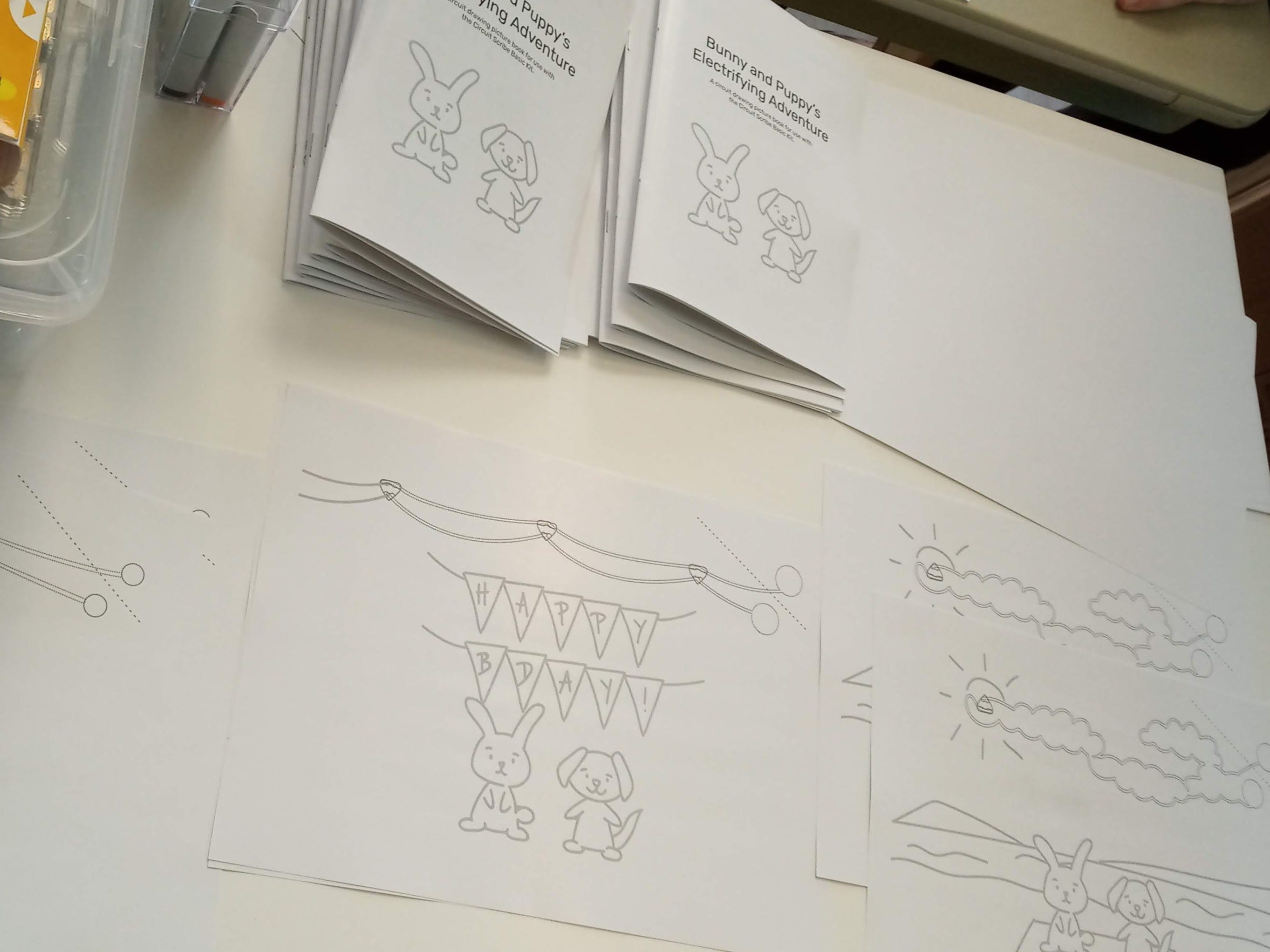
I came up with the idea of illustrating a worksheet or short story in order to incorporate visual designs beyond the typical circuit diagrams. I also felt that the narrative could provide another way to capture attention or present the flow of ideas.
Since the Kit’s own booklet starts off with the basic components of an electrical circuit, I decided to start the extension booklet with the basic design elements.
The next few pages introduce the characters, Bunny and Puppy, before following with a simple story about their trip to the beach. (Writing a story with activities in between made me feel like I was writing primary school word problems for a math paper…)
Interestingly, I realised that I dwelled longer than I would have expected on choosing pronoun references for the characters.
Humanise the animals with personal pronouns (“he”/”she”) rather than neuter (“it”)?
- Since the characters are the story’s protagonists performing human-like activities of going to the beach and having a picnic, as opposed to being pets in a human-centric story?
But masculine or feminine pronouns?
- Are certain animals too often portrayed in children’s fiction as a certain gender? What if kids form the perception that all dogs are boys?
How about gender-neutral (“they”)?
- Amidst the rising discourse on gender neutrality? But the pronoun is still more often used as a plural in Singapore, as with how it has conventionally functioned — would that cause confusion?
In the end, I settled on using “he”/”she”, on the basis that I wanted the characters to exhibit human-like qualities, but did not want to compromise on the understandability or clarity for a Singaporean audience.
Adapting the multiple-page booklet into a single-page activity
As with Tinkercademy’s other courses, activities can be scaled to different contexts and audiences, based on the nature and duration of the particular session. From the concept and activities of the booklet, I decided to adapt a few single-sheet pages to serve as quick 10-minute station activities.
In order to make it possible for children to take these activity sheets home without having to buy the Circuit Scribe Basic Kit, I opted for lower-cost alternatives for the materials used. Making the activity sheet independent of the Kit meant that I swapped the Circuit Scribe Modules (such as the LED and power modules) for Chibitronics circuit stickers and button batteries.
Often, creativity is seen as “Think out of the box!” and “The sky’s the limit!”, but I realised limitations (eg. budget constraints) and specific aims can actually serve to enhance creativity rather than be a hindering restriction. The specificity of the needs of the target audience (kids learning about circuits) allowed me to have a clear goal of what I should be creating, such that I questioned each step in the process against how the target group would receive and react to my product. Of course, I’m not sure how useful it actually was after being released, but it was a fun experience for me drafting, getting feedback, and editing my project!