

Editor’s note: Hongying joined us for a half-year-long internship and did… almost everything! We were really, really impressed with her drive, curiosity, work ethic, and resourcefulness. She’s gone on to study at the Singapore Management University, where we’re sure she’ll be fantastic. Here’s her recap of her experience with us:

In December, I was looking for an internship after taking a break following the A-levels. I was asking around and searching on various online internship portals for an exciting internship that would allow me to challenge myself, and explore my interests in both the fields of technology and business.
My friend, who was part of a JC programme called INVENT, suggested that I try out for an internship at Tinkertanker. The company had previously taught me for my secondary school’s Infocomm Club Front-end Web Development lessons (HTML, CSS, Javascript), and coached me for a game development competition back in secondary school. Having personally benefited from their interactive curriculum, I decided to take my friend’s suggestion and apply for an internship.
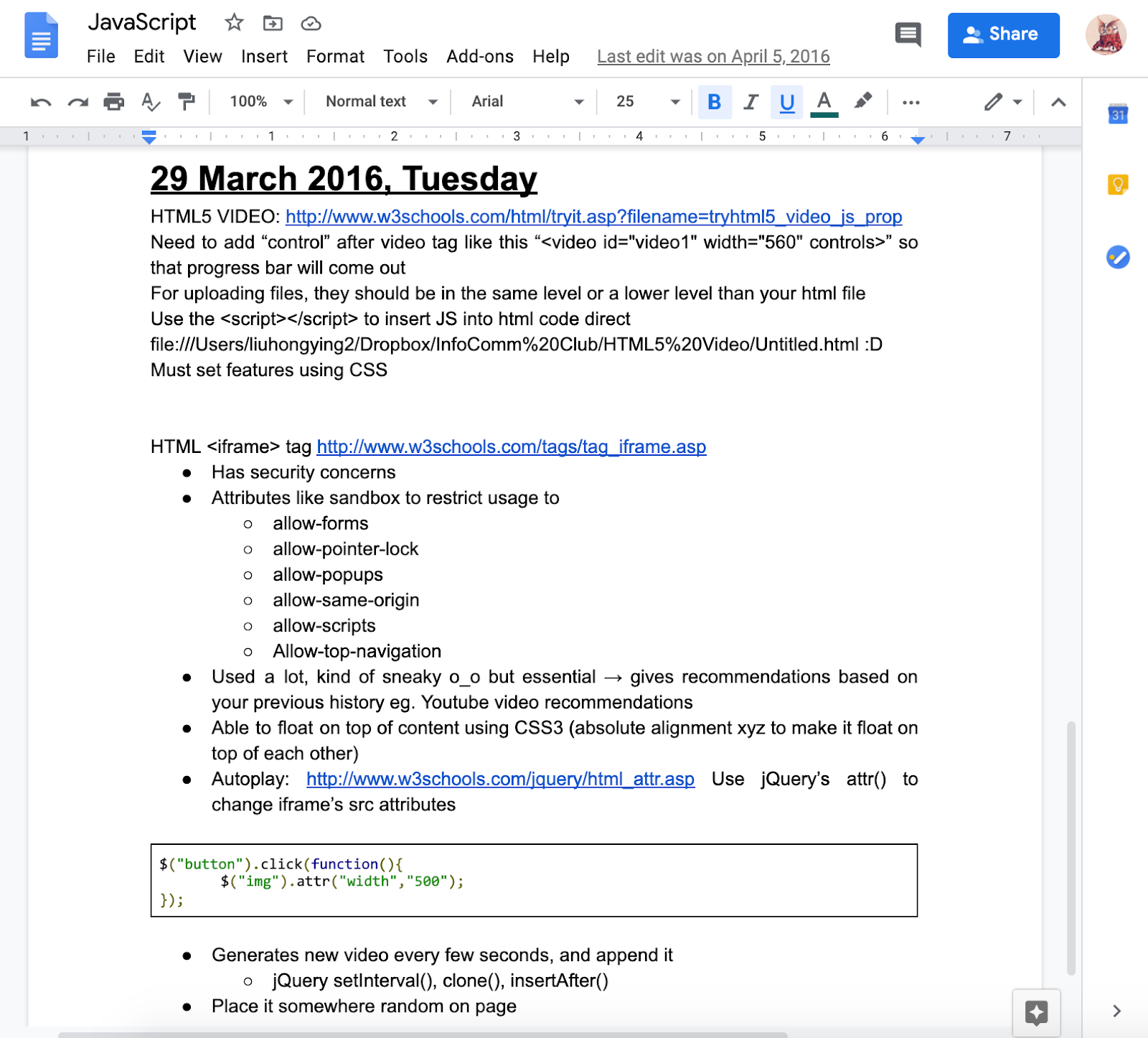
Some of my Tinkercademy JavaScript class notes way back in secondary school 😂
Right from the get-go, Tinkertanker’s internship opportunity stood out to me. Mr Soon told me about the different ways where I could be involved — from hardware, making, coding projects in a wide variety of programming languages, to teaching, marketing and social media content creation across its various business units. There were so many avenues where I could contribute and play a pivotal role in business operations, unlike many other internship opportunities, that seemed to largely revolve around routine administrative tasks.
Thankfully, I was really fortunate to be offered an internship position, and I’ve not looked back since. It turned out to be exactly what I was looking for, and so much more! I had the opportunity to be a part of Tinkercademy and Let’s Get Hacking (a tutorial site and movement for makers) too, which allowed me to experience so many different and exciting things that I wouldn’t have otherwise — hardware, software, curriculum, teaching, content creation, marketing, and much more!
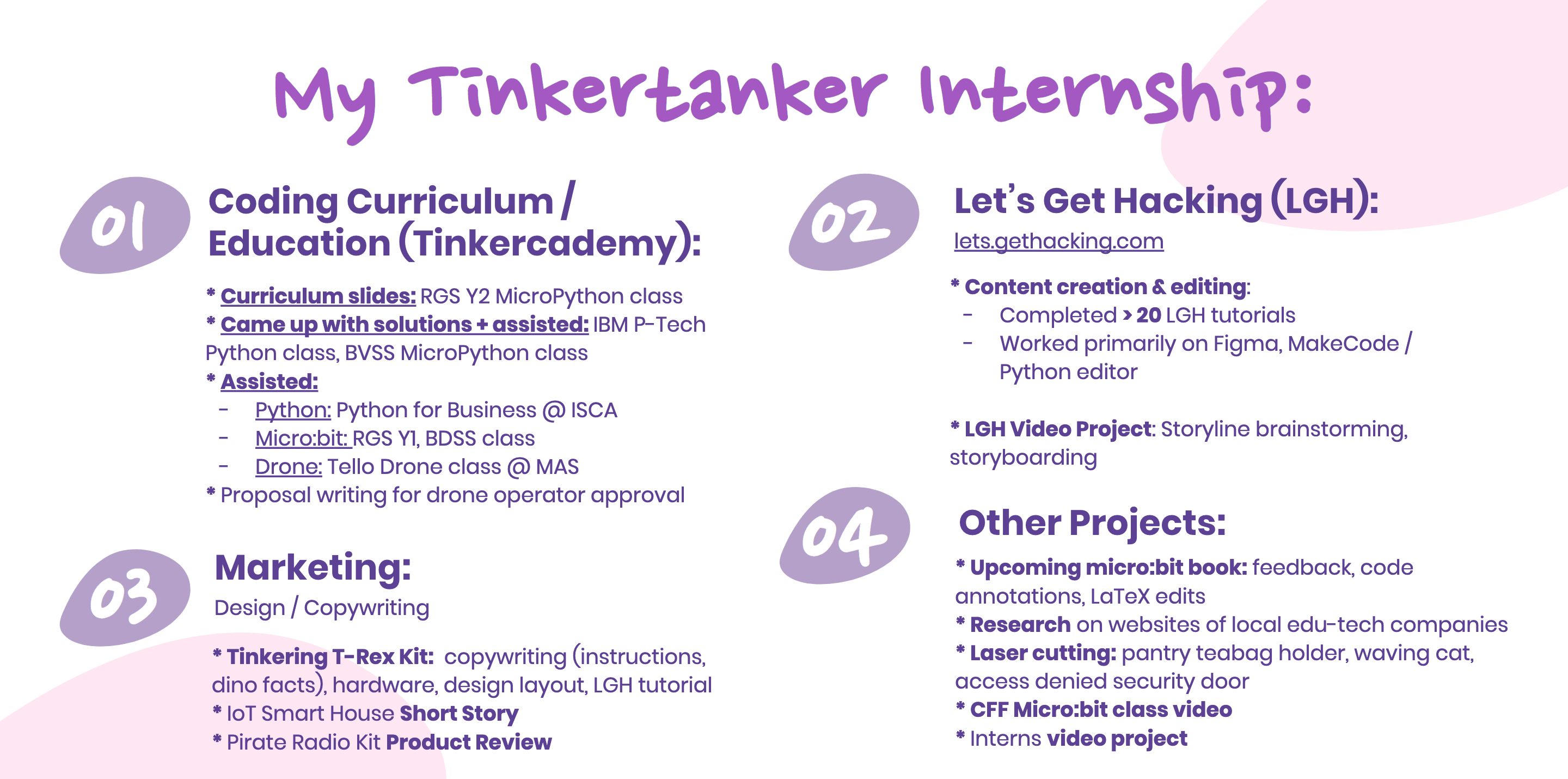
An overview of what I did over my internship!
I am very grateful for the opportunity to intern at this vibrant company. With a wide variety of business operations and arms (Tinkercademy, Get Hacking online store, GuestDay iPad guest registration, ArcLab mobile training SaaS platform, Let’s Get Hacking tutorial site), there’s really never a dull moment at Tinkertanker.
Without further ado, here’s the story of my exciting and fulfilling internship at Tinkertanker over the past half a year!

With Tinkertanker being an edtech company, I was very fortunate to have been given the opportunity to be involved in their curriculum efforts for Tinkercademy. I helped out at their various Python, micro:bit classes (and even at a drone class once!), and even got to chance to develop and improve upon curriculum and materials for these classes. This was an experience that I am truly grateful for, as it not only allowed me to discover my interests in the education side of things, but also allowed me to reinforce concepts I’d learnt by putting them to practical application. I had the opportunity to work with and thus learn more about not just Python basics, Python Turtle, but also data science with Pandas, and even new things like writing code for the BBC micro:bit hardware, which I was not exposed to before. New experiences like coding for hardware offered me a great learning opportunity to learn more about Python and its various uses.
Python for Business
Not long after I joined, I had the opportunity to help out at a 2-day Python for Business course for accountants. This course was primarily taught in Jupyter notebooks and is a relatively intensive one, aimed at familiarising participants with Python — all the way from basic Python and programming concepts, to dataframes, Python libraries like matplotlib and plot.ly for data visualisation, and tweepy for accessing the Twitter API.
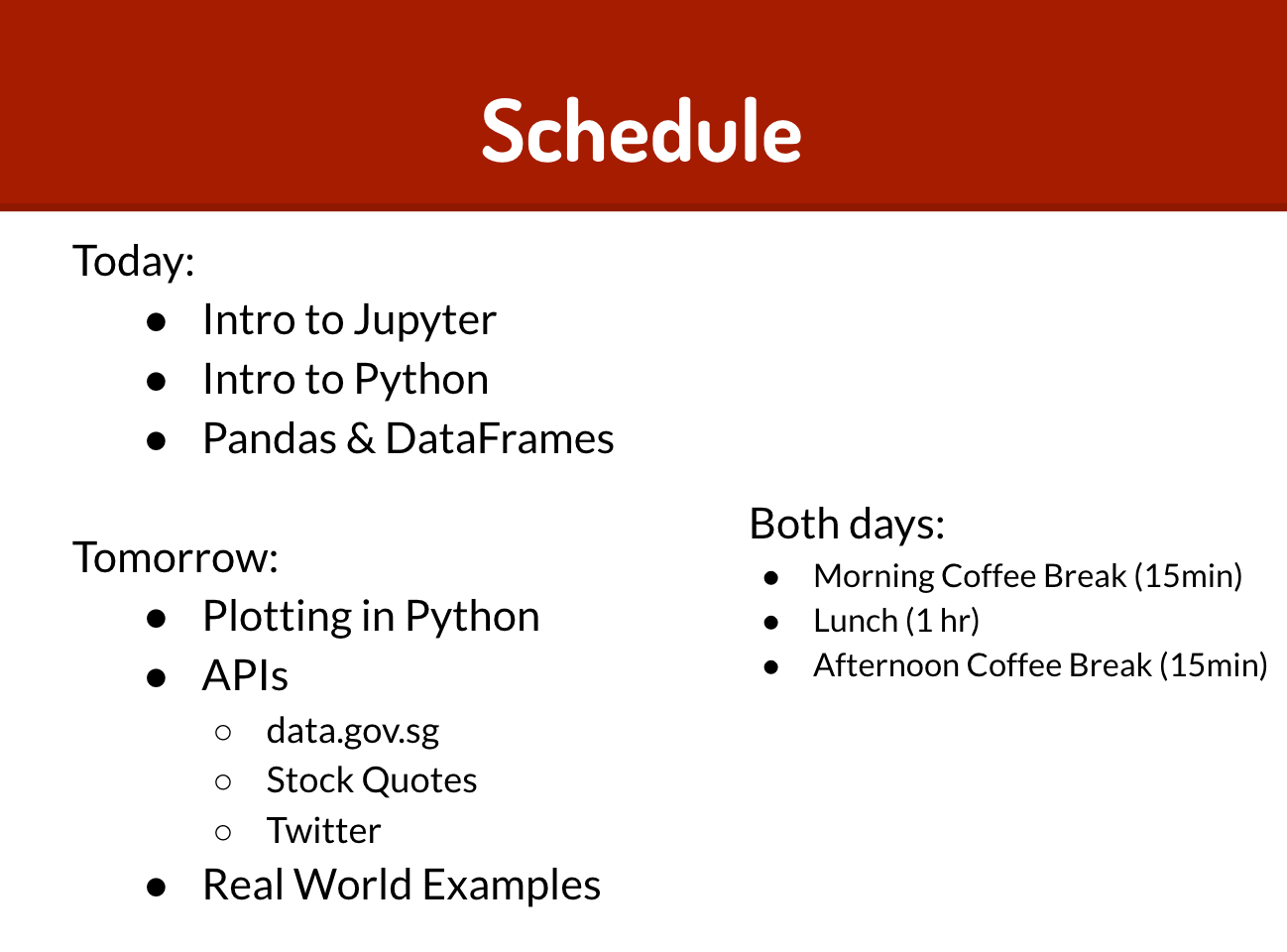
Python for Business Class Schedule
Being tasked to address the participants’ queries meant that I had to familiarise myself with the course materials to help them with debugging their code. Having to read through their code and identify errors quickly so that they don’t miss out too much of the lesson also taught me the importance of working efficiently and put my knowledge and skills to the test. This was a valuable experience that really helped me to deepen my knowledge of Python.
Interacting with and talking to the participants also allowed me to find out more about their work, which was also really interesting. I clearly remember even till now, one accountant showing me one of her Excel workbooks and my shock at the number of sheets and numbers on just that single workbook!
P-Tech Class
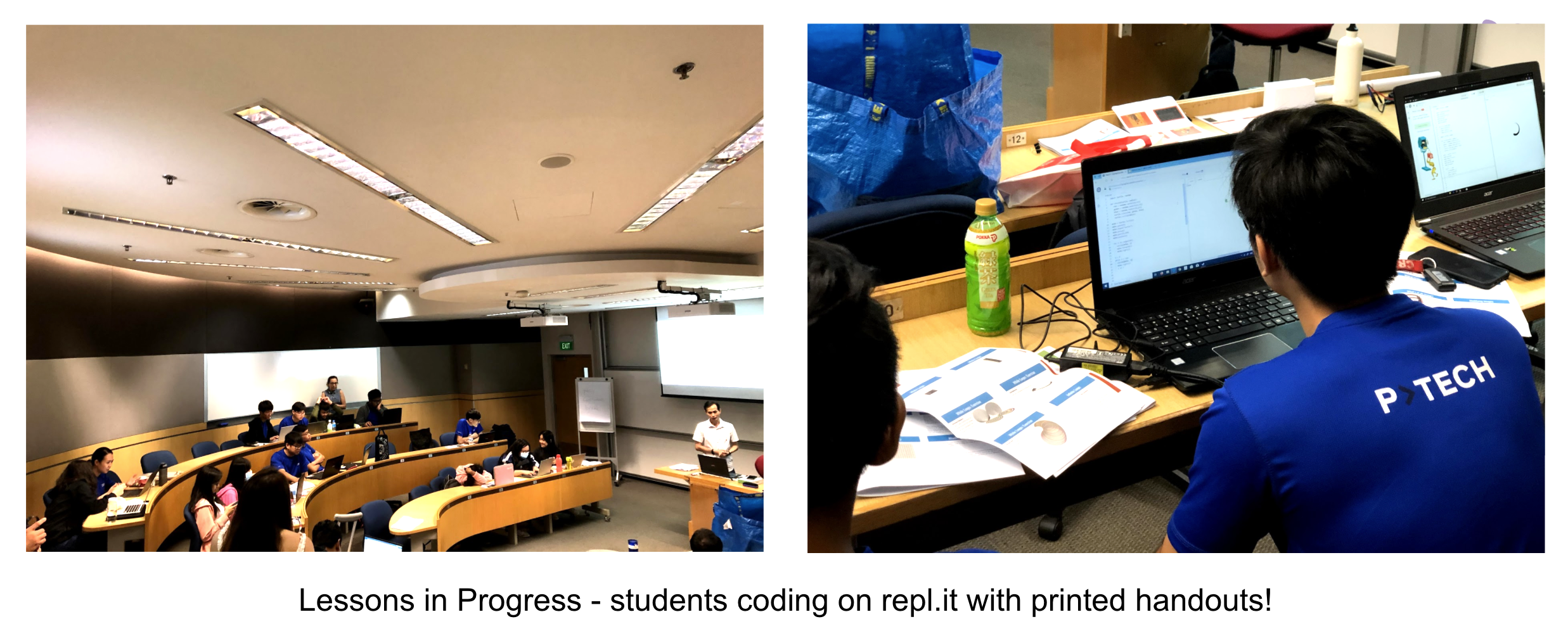
Other than helping out with the above course for adult learners, I also had the opportunity to be involved in a course for ITE students pursuing IT-related courses, called P-Tech. I was not only given the opportunity to help out physically at lessons to address participants’ queries and help out with code debugging, but also had the opportunity to create and update slides, and come up with the solutions to the coding exercises on the existing slides before the lesson, to facilitate the instructor’s teaching. It was a very interesting class conducted on the collaborative online IDE repl.it, that took students all the way from an introduction to Python and programming concepts, to drawing generative art with the turtle library and image manipulation with the pillow library.
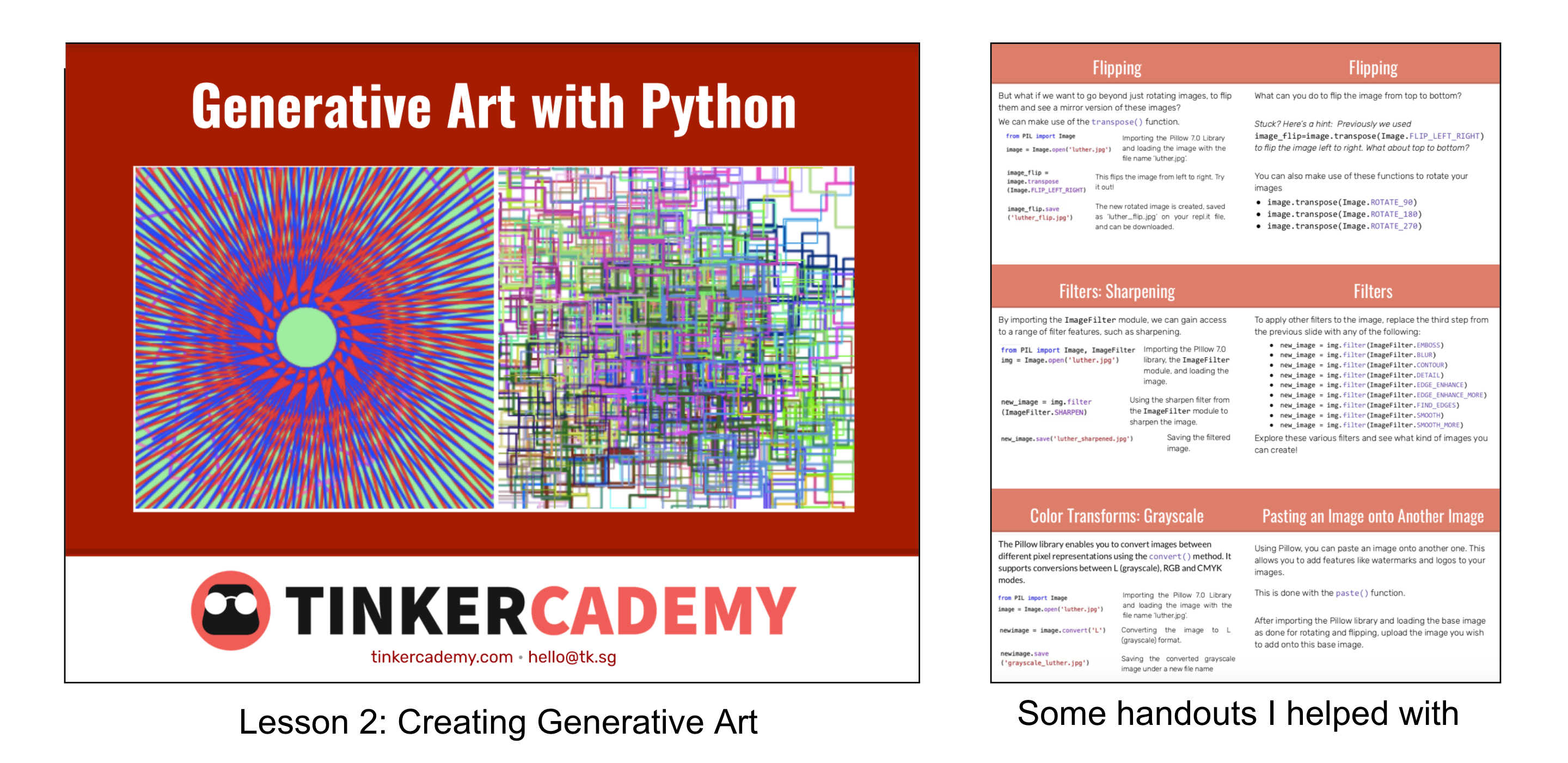
This experience also exposed me to new Python libraries like pillow, and coming up with solutions to the existing exercises allowed me to put my knowledge to practice and reinforce my learning of Python. Interacting with the students was also a very fun experience that I looked forward to. Seeing them went from almost 0 Python experience, and feeling uncertain about their abilities to attempt the exercises, to eventually solving some exercises on their own was personally very fulfilling for me.
It was also here where I discovered my interest for teaching and the education side of things, as I really looked forward to the weekly sessions. I found a lot of joy interacting with the students and fulfilment when I could help them better understand what was taught. This spurred me to continue helping out with the company’s other classes at other schools too. (Fun fact, It was also here where I met the Tinkercademy instructor who taught me at my secondary school’s Infocomm Club sessions again, after 4 years!)
Curriculum Development for MicroPython Classes
My experience developing some slides and answers for the IBM P-tech class also provided me with valuable experience in curriculum development, and I was really grateful when I was offered the opportunity by Mr Soon to create curriculum slides for a series of MicroPython lessons, based on a scheme of work. Aimed at introducing and familiarising Python to students who’ve had some block-based programming experience, the curriculum included not just basic Python concepts and exercises, but also made use of the BBC micro:bit hardware in some lessons, as an interactive medium to ease this transition (MicroPython is basically Python code for the micro:bit hardware!). This allowed me to gain new experiences with coding for hardware. Exercises included creating a mood logger, random dice and magic 8-ball on the micro:bit, and even controlling a ring:bit car powered by the micro:bit!
A really interesting experience for me would definitely be the ring:bit car. As opposed to coding the car on MakeCode where we can easily import the “ringbitcar” extension and drag out the relevant movement control blocks, there isn’t a Python library for the ring:bit car, which meant that the servos for the wheels have to be manually coded and various movement functions have to be manually defined. This required knowledge of coding for hardware, such as setting the hertz and pulse cycles for sending signals to the servo wheels of the car.
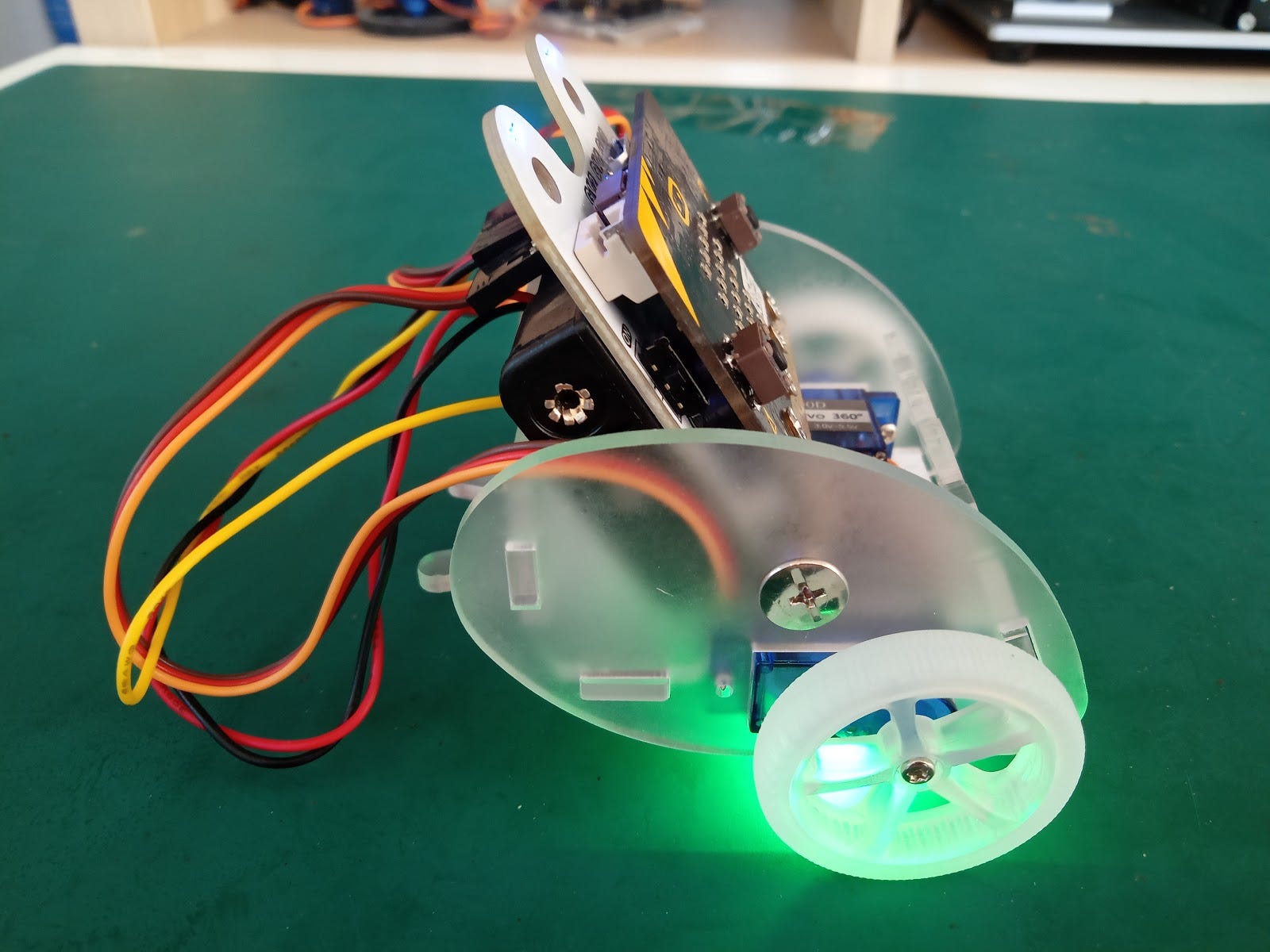
A powered ring:bit car, ready to go!
I’m really grateful to have had the help of another intern, Navneeth, who figured out the Python code quickly and was really generous sharing the code and explaining each step to me so I could understand the code and do up the lesson slides accordingly. This experience definitely allowed me to learn more about Python, and specifically for coding hardware. While I wouldn’t be able to see this ring:bit car lesson in action before leaving, I hope that the students will have a lot of fun with this lesson!
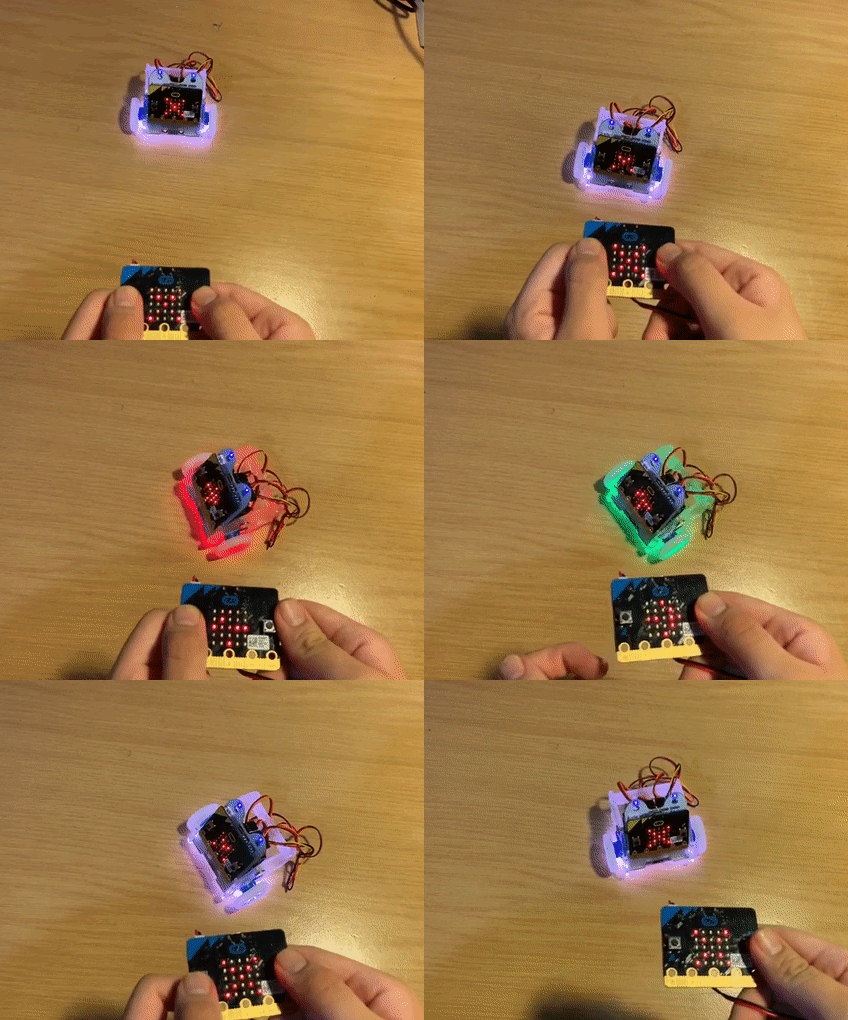
Remote-controlled ring:bit car, using 2 micro:bits
Additionally, creating detailed step-by-step explanations for students’ easy reference also allowed me to deepen my understanding of Python concepts and libraries like turtle for example. Some of these exercises were part of the P-Tech class previously too, and creating step-by-step explanations this time round allowed me to further reinforce my understanding of Python. Here are some interesting Python turtle exercises for the students to try out, and a section of a step-by-step guide to one of them, that makes use of loops and functions!
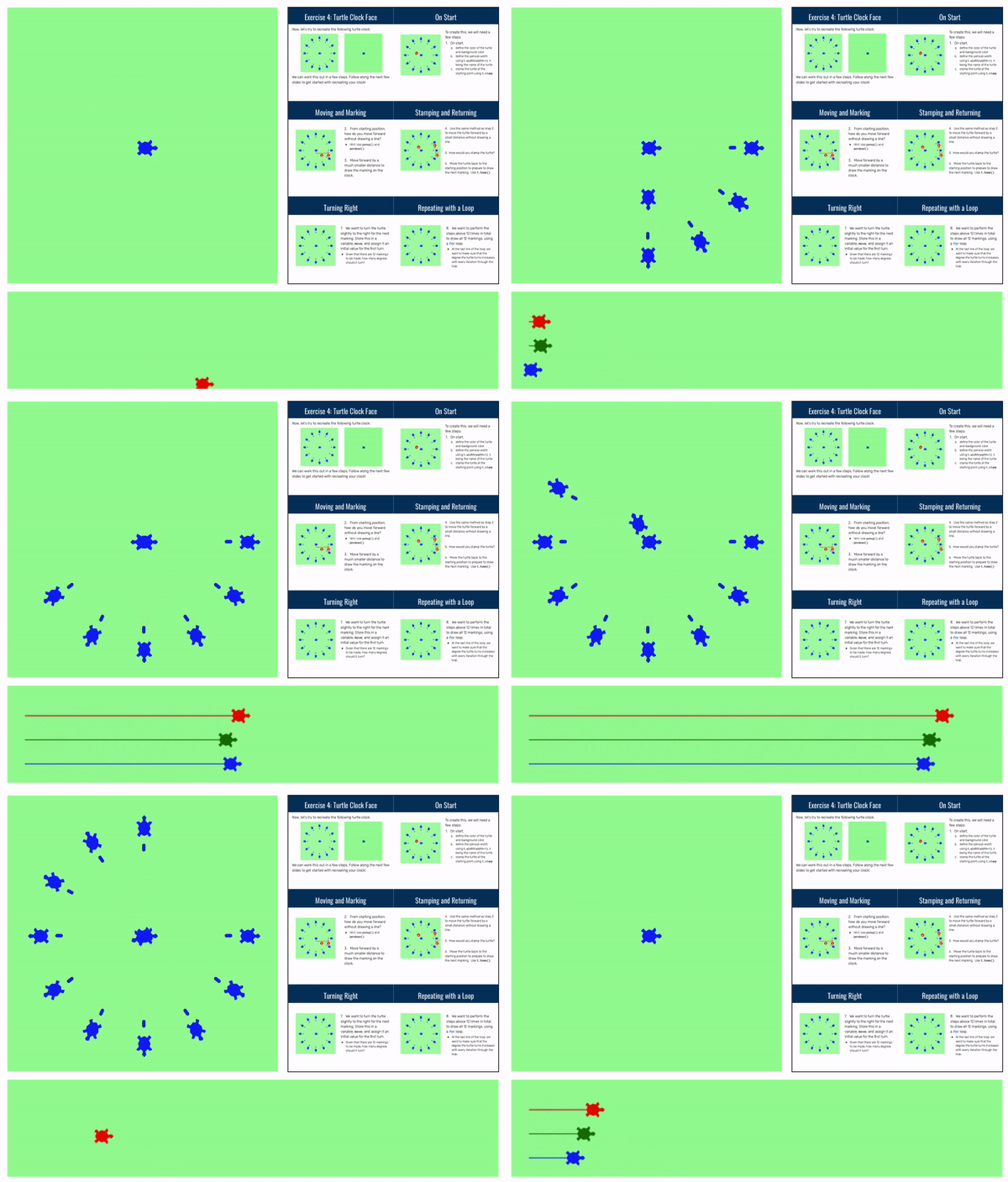
Some Python Turtle Exercises & Solutions
I am also very grateful to have been given the opportunity to help out with these lessons at school. Seeing the students learn with the aid of the slides I created was also very fulfilling for me, and I even met my secondary school teachers who were sitting in to observe the lesson (really touched that they still remembered me :’))!
Other than the RGS MicroPython curriculum, I also helped to create some Python solution slides for other MicroPython lessons for Infocomm Club CCA members, and assisted during the lessons in school to address their queries and debug their code promptly. Unlike MakeCode, where there is a ‘Games’ drawer to easily create and track sprites and points, there isn’t a corresponding library on Python. This experience, along with Mr Akmal’s patient help teaching and explaining the code to me which I am very grateful for, allowed me to deepen my understanding of Python and coding for the micro:bit hardware.
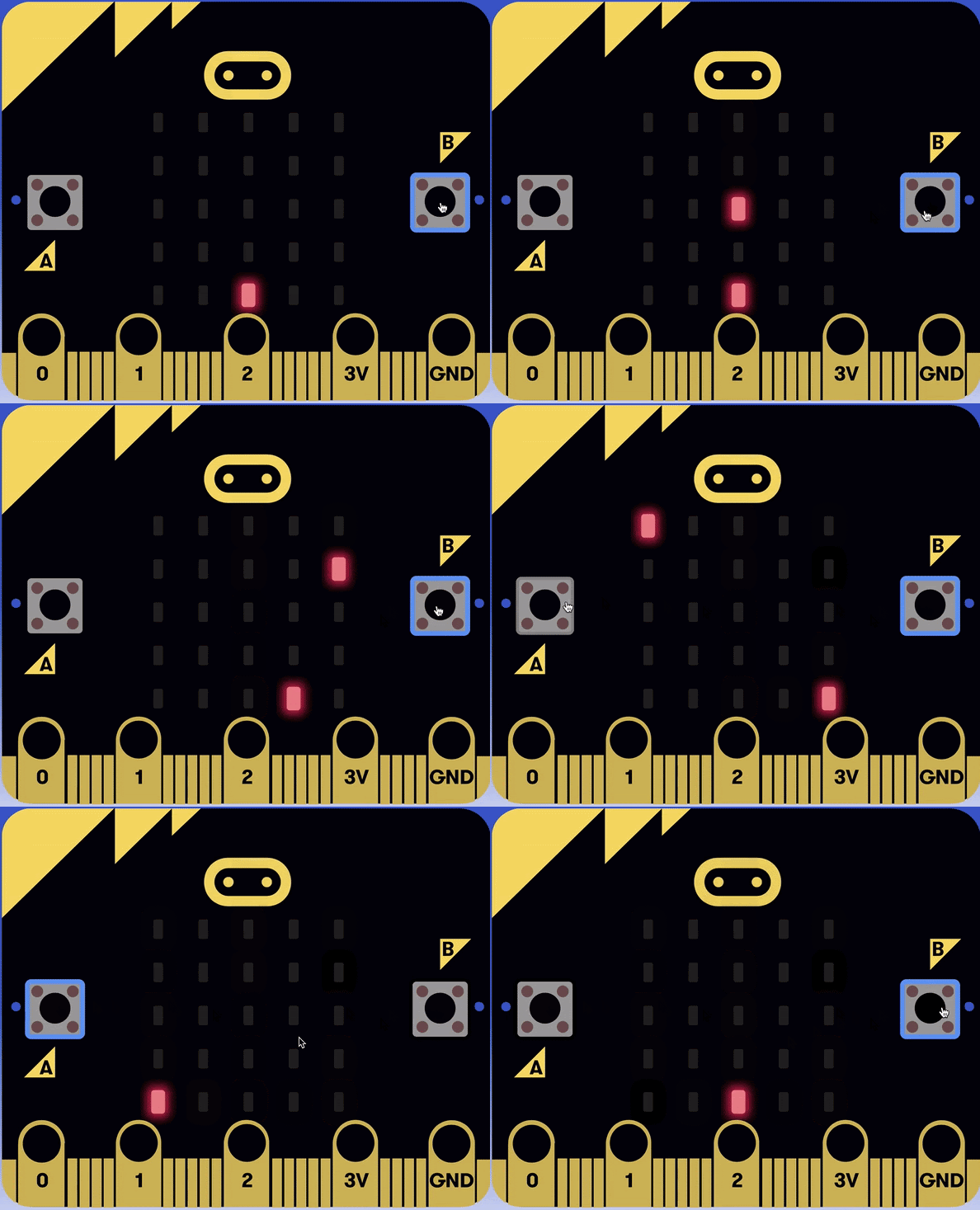
Catch the Falling Item Game
Micro:bit Lessons
Other than the above-mentioned Python classes and curriculum, I also wrote documentation for various micro:bit components as a guide for another school. This included a basic overview of their functionalities, connecting and usage with the micro:bit, and creating sample projects with these components, to control them when connected to the micro:bit. This allowed me to familiarise myself with the micro:bit hardware, which was an interesting experience as it was not something that I was exposed to, or aware of before.
Additionally, I was also given the opportunity to assist at the micro:bit classes in different secondary schools around Singapore too. Through the interactive medium of the micro:bit and fun exercises like the Zen Balance Game and smart plant watering system that Tinkercademy incorporated into the curriculum, these lower secondary school students were given a fun and gentle introduction to programming. I really enjoyed helping the students, and I found it eye-opening witnessing how such a small device like the micro:bit can create so many different possibilities and captivate students’ interests for them to find out and learn more about coding!
Tello Drone
Other than Python and the micro:bit, I also worked with the Tello Drone. I don’t own a drone and haven’t played with a drone before either, so this was an exciting first-time experience for me. I filled up a CAAS proposal to apply for authorisation to use Tello Drones at Tinkercademy classes, and had the opportunity to help out at a showcase event, where I manned the drones booth to introduce the Year 1 students to the Tinkercademy drone class. It was a fun experience and the students were super excited seeing the drone flown around!
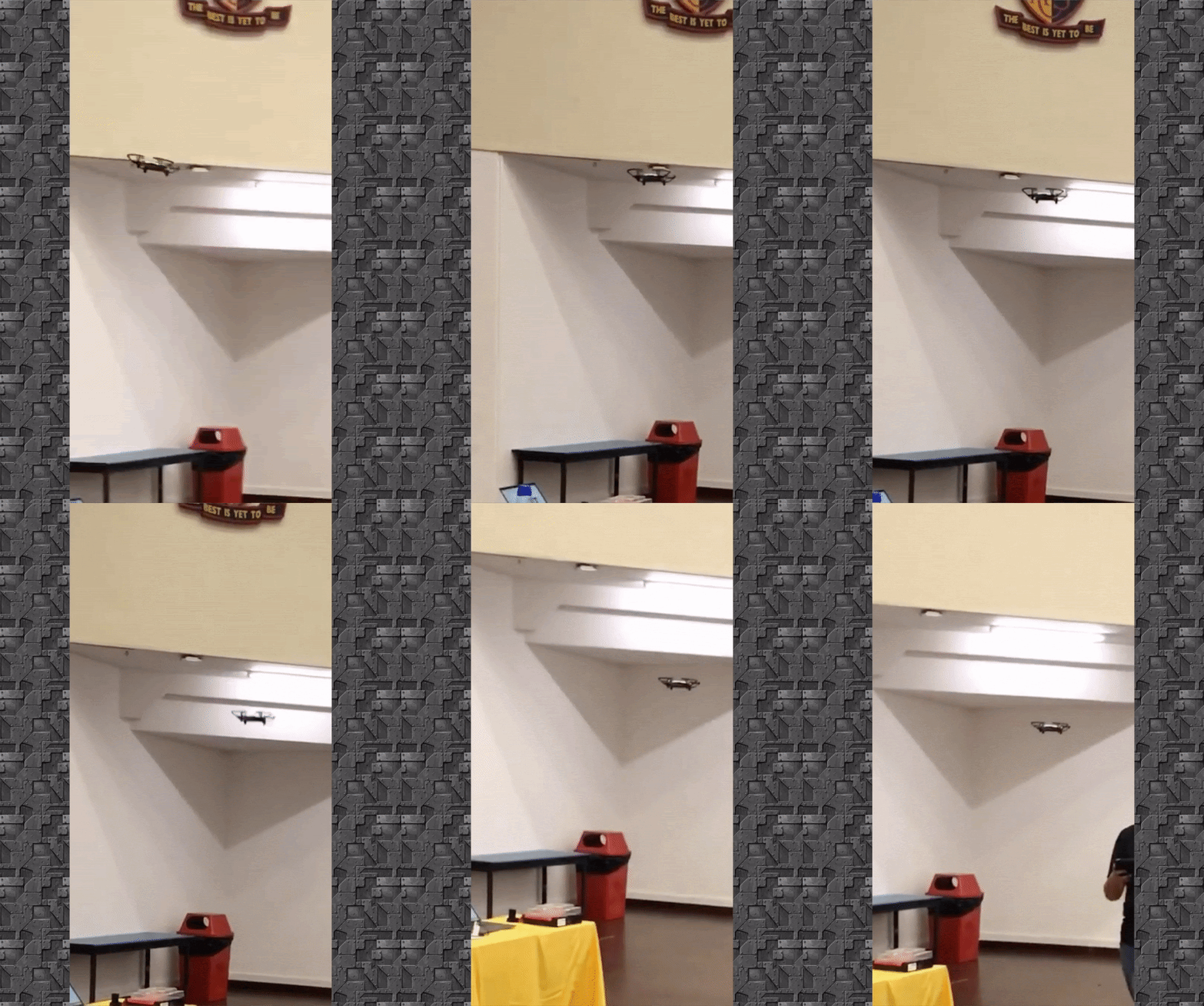
Showcase Event with Drone
I was also given the opportunity to assist at a corporate drone class conducted at a corporate workshop, for executive teambuilding. The participants were introduced to block-based programming to control the drone on DroneBlocks, and it was a great experience seeing the adult participants have so much fun with the drone too, and being intrigued by coding!

Aside from the above curriculum and teaching efforts, another large part of what I was involved in is the content editing and creation for lets.gethacking.com, especially during the circuit breaker period where the above mentioned physical classes were all postponed. Let’s Get Hacking is the company’s online tutorial and movement for makers, and the website features a whole host of micro:bit tutorials for makers with differing levels of experience and materials, from simple ones like the Electro Theremin to projects that require more hands-on craft work like the Ang Bao Collector, games like Flappy Bird and even a special 12 Days of Christmas series!
Here’s an overview of some of the more interesting projects, out of the >20 LGH tutorials I created!
I had the opportunity to create and edit content for the Let’s Get Hacking site, which was a new and exciting experience for me. I mainly worked with editing old tutorials in both MakeCode and Python — where I edited any original code that doesn’t work as intended, rewrote or summarised lengthy steps, proofread and edited the steps, and physically rebuilt the project to take new step-by-step pictures and videos. I am really grateful to Hetty for always being really willing to help me out whenever I had any questions with either the coding or making, and to both her and two designer interns, Jing Ting and Nurfazli for patiently adding really nice backgrounds and designs to the photos I take. It was definitely a team effort getting these tutorials up, and I am really grateful for everyone’s help!
My experience working with these tutorials also reinforced my understanding of coding and Python when I worked with MicroPython projects, especially when I had to make some changes to the original code or add comments or written steps to better explain the code.
Here is my workflow process, and a sample of a step from two Figma files, featuring images taken from multiple angles for each step.
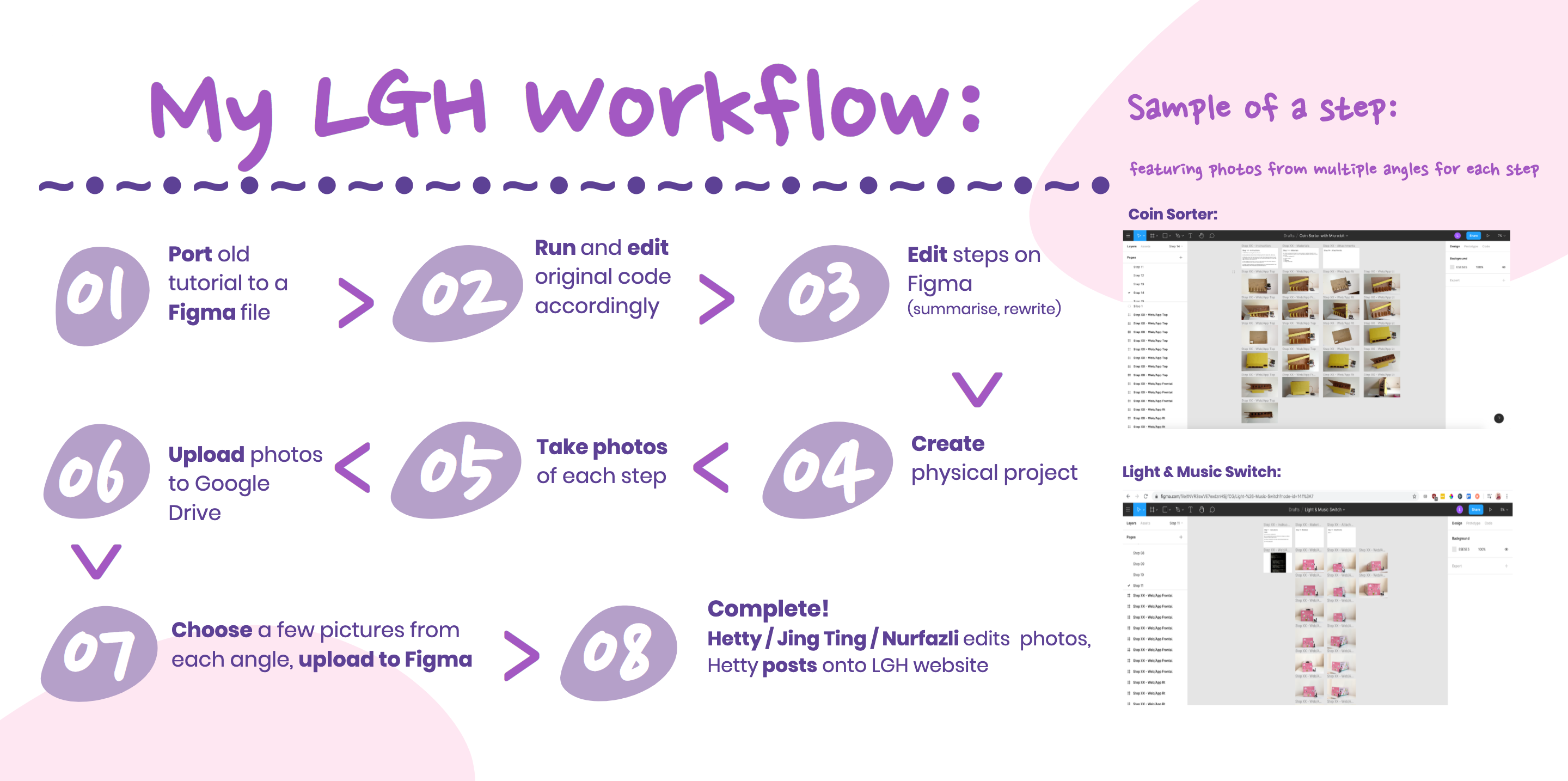
My LGH Workflow Process
This experience also allowed me to exercise my creativity, as I added my own twist to some of these old tutorials to spice them up, such as for the “Light & Music Switch” tutorial, where I added a music buzzer component to the code and some making to the project so it wouldn’t be just the micro:bit components alone. Turning the potentiometer connected to the Tinkercademy breakout board to different extents lights up a different LED and plays a different music note through the buzzer.
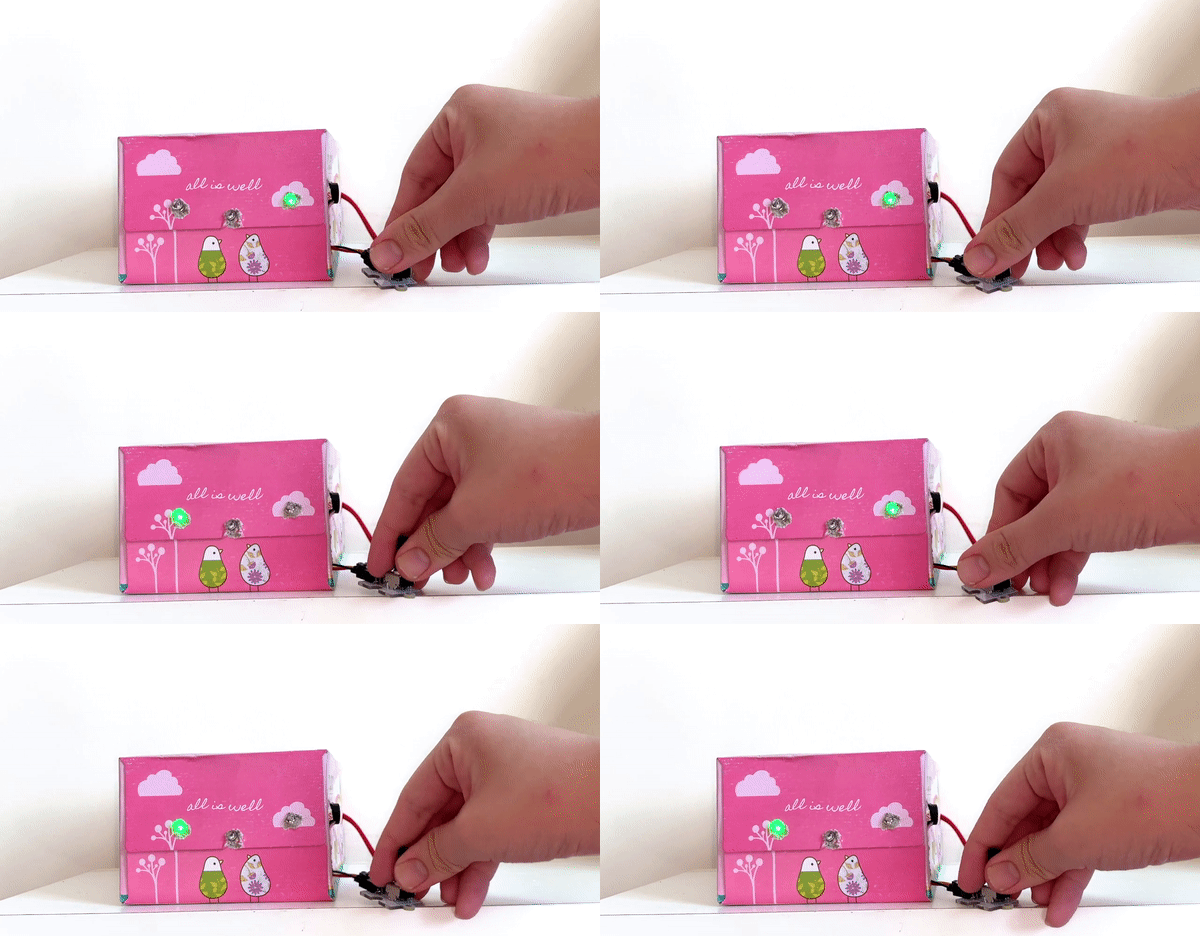
Light & Music Switch Project
My personal favourite however, would have to be the plant monitoring device! It makes use of a soil moisture sensor to automatically detect when the soil is below a certain moisture level and alert the owner to water the plant through an alert music player through the buzzer and text on a OLED display! Fun fact though, the “plant” below is not even an actual plant! Can you guess what I used instead?
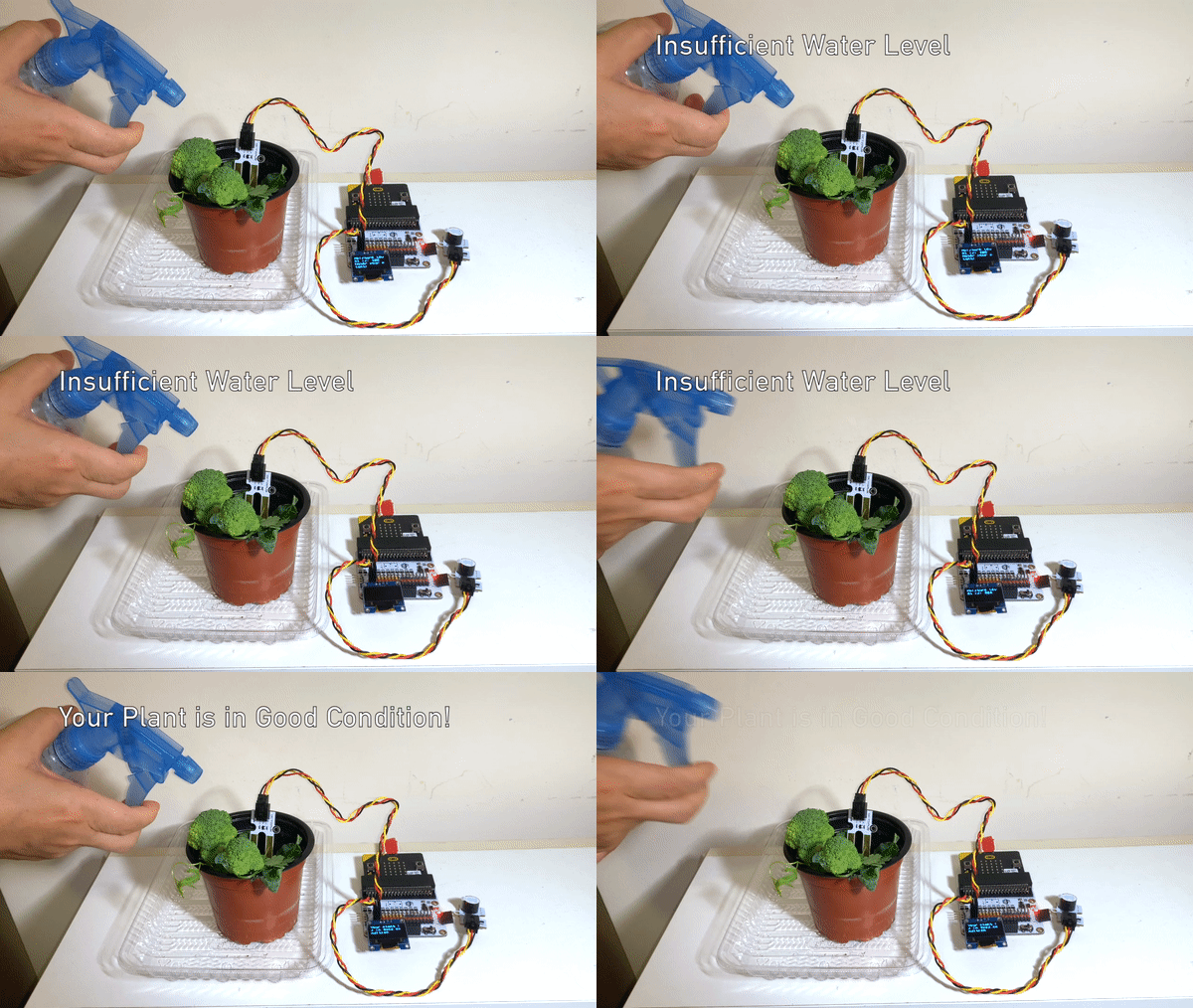
Smart Plant Monitoring Device (what’s that plant though?)
On the other hand, my favourite game would probably have to be the Snake Game! It requires intense concentration and is so difficult to score that it’s addictive and so satisfying when I achieve a higher score than I did previously. If you’re interested, all you need is a BBC micro:bit, microUSB cable, internet access to access the official online micro:bit Python editor, and you’ll be able to quickly recreate this classic Nokia game on your micro:bit following our tutorial! I definitely had way too much fun as a child playing this on my mum’s Nokia phone, and now on the micro:bit …
lets.gethacking.com also hosts a whole bunch of other fun tutorials like this so if you’re interested, feel free to head over to the site to check it out! The tutorials are pitched at a range of difficulty levels, and some even just require a BBC micro:bit and microUSB cable to complete. Fast, fun and easy! If you do try them out, don’t forget to tag Tinkercademy and post it up on social media with the #letsgethacking hashtag too! Happy tinkering! :)
Let’s Get Hacking Video Project
Other than the tutorials, I was also part of a video project aimed at promoting the Let’s Get Hacking movement, where I was involved in discussions for a video storyline. This was a new experience for me, as I’d always been on the “receiving” end watching loads of videos in my free time but never actually had much experience brainstorming or working on one! It was a really enjoyable experience that I’m grateful for, as it encouraged me to think out of the box, to come up with a video idea that would best capture the essence of the Let’s Get Hacking site and movement and convey it to our target audience. It also exposed me to business strategy and thinking — in coming up with a video that would maximise our outreach and appeal to our target audience best to achieve the business goals, with the amount of time and money we invest into making and publicising it.
I looked forward to coming up with the ideas and the meetings every week to discuss the project! While this video project is still in the works and currently on hold due to the COVID situation, here’s one of the initial storyboards that another intern, Faisal and I came up with, according to the feedback we received from Mr Akmal and Hetty! Credits to them and especially Faisal too for the ideas!
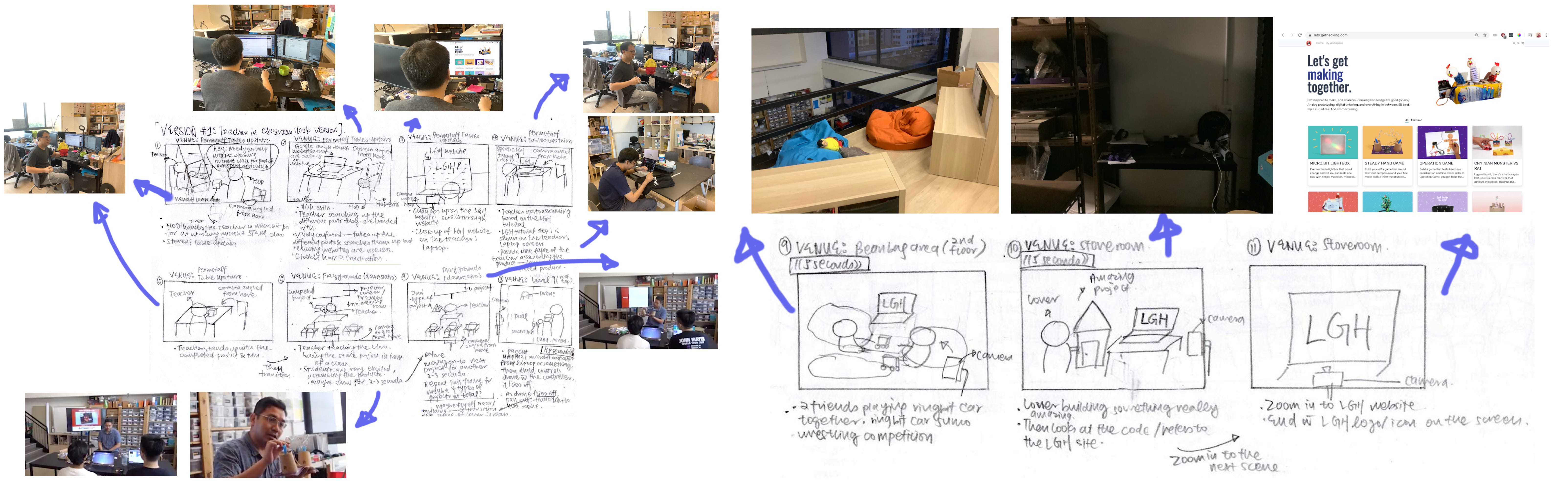
One of our initial storyboard versions

Being a company that also operates an online Get Hacking store at gethacking.com for a whole bunch of products for learning coding, making and tinkering, I was also involved in various marketing efforts to promote the company’s products. This allowed me to gain more insight into marketing, in terms of content creation, copywriting, and even design!
Tinkering T-Rex Kit Content Creation
For example, I was given the opportunity to play a role in the content creation for the booklet of the company’s upcoming Tinkering T-Rex Kit. The t-rex kit is a collaboration with a talented cardboard sculptor Bartholomew Ting, who designed the cardboard t-rex, while Tinkertanker is in charge of the micro:bit hardware that allows the t-rex to move and roar whenever movement is detected. You can’t hear the t-rex roaring in the GIF below, but it does!
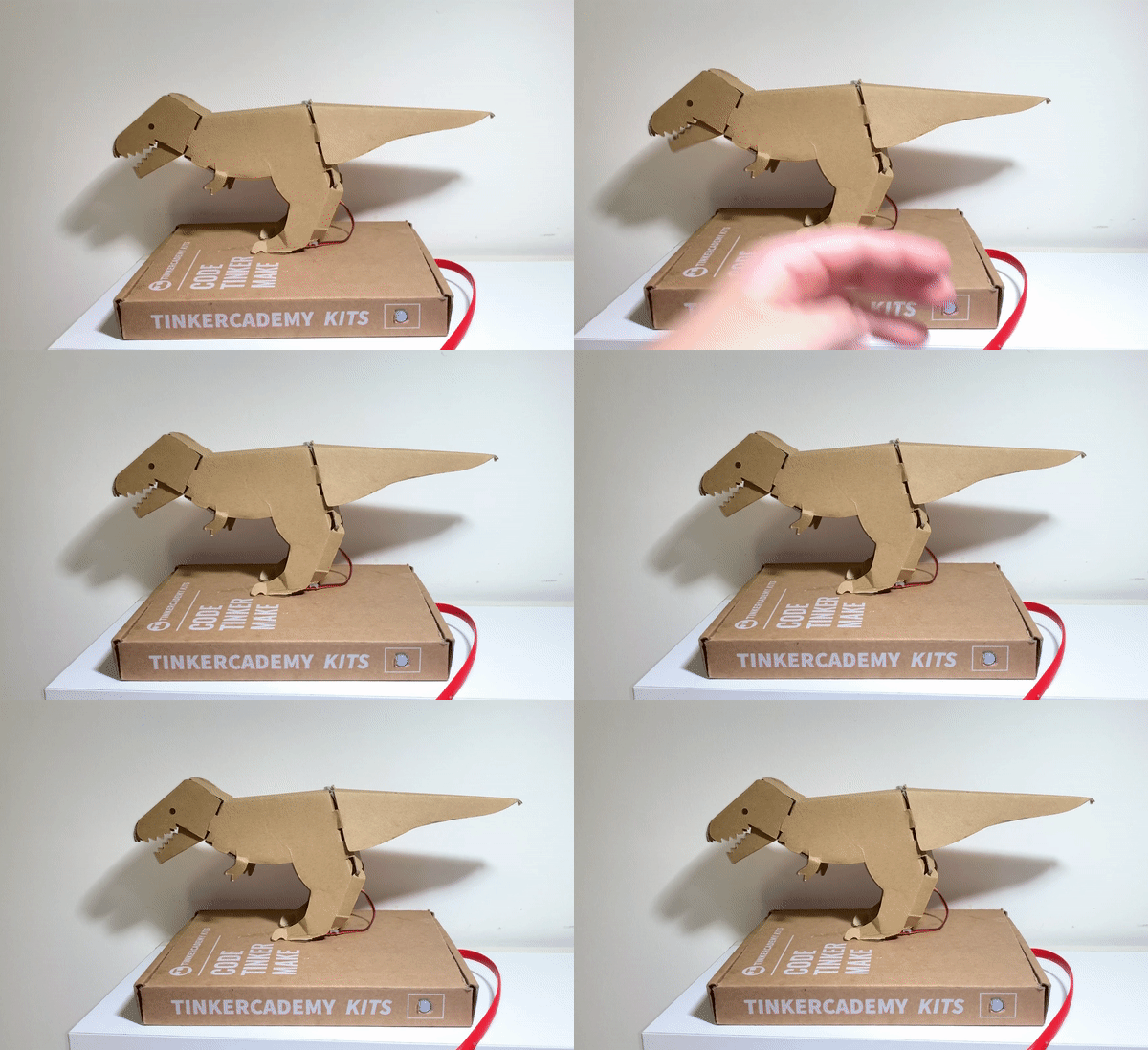
T-Rex Kit
I was tasked to work on the booklet to accompany the kit, aimed at providing instructions to set up the kit and some fun dinosaur facts. I worked on figuring out the circuitry for the hardware, writing the step-by-step instructions (assembly, circuitry, coding), copywriting for other parts of the booklet (including some fun dinosaur facts too!), and design layout for the booklet. Jing Ting, a talented design intern, did up the illustrations for each step (assembly, circuitry, coding), and worked closely with me on the design and layout of the booklet too.
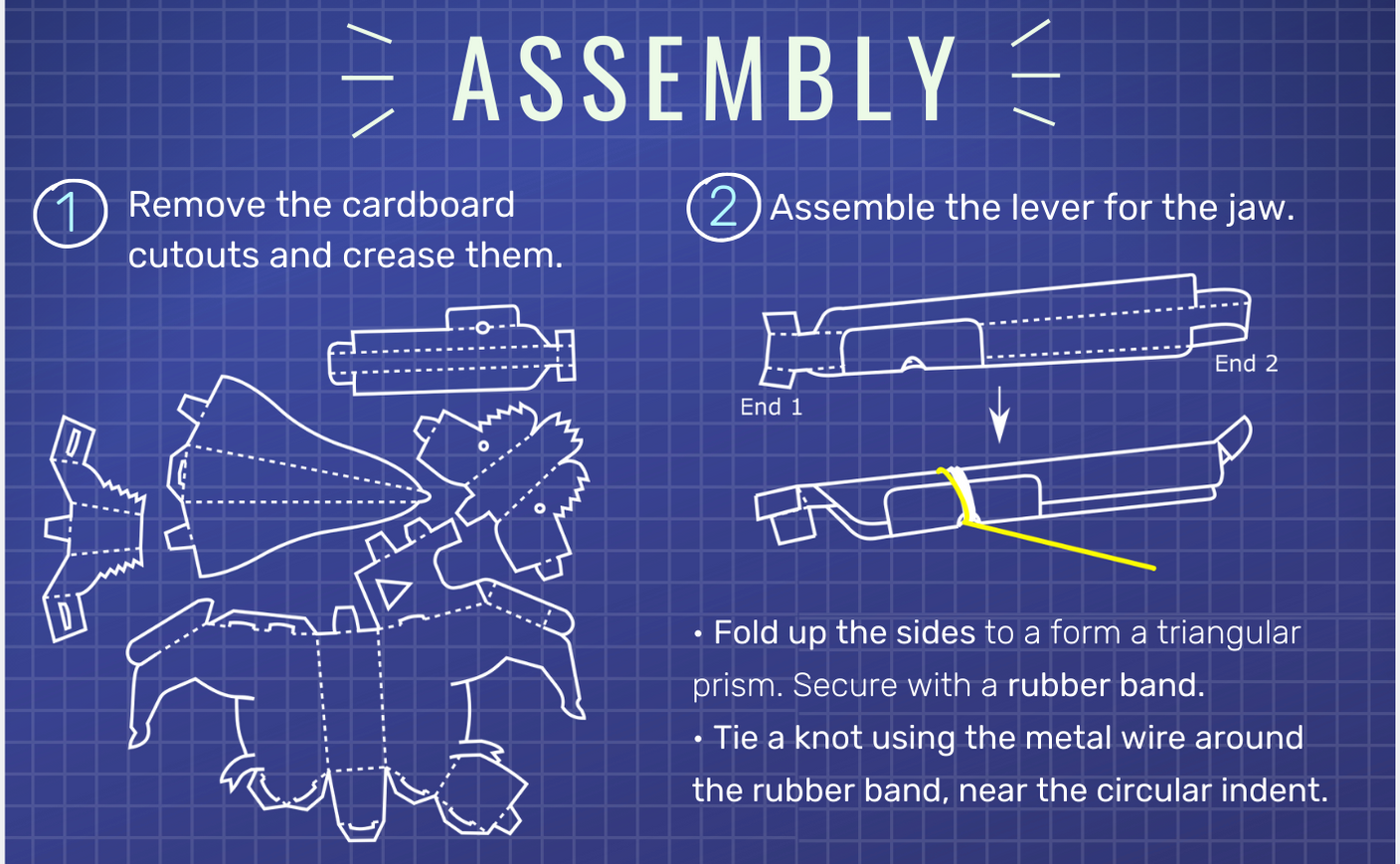
T-Rex Kit Booklet Preview, with illustrations by Jing Ting
I am very grateful for this opportunity that allowed me to play a key role in the company’s t-rex kit marketing efforts, and learn more about marketing and even design, as we made various versions of the booklet with different colour schemes. Sitting in and listening to the meetings on the company’s plans for roll-out and publicity also allowed me to gain some crucial insights into the marketing process, as this was a real-life business case scenario.
More importantly, working closely with Jing Ting throughout this whole process to refine the booklet over two revisions also taught me the importance of being a team player — in terms of communicating clearly, working efficiently and reliably to complete our individual work according to schedule, being flexible and adapting to changes, and offering support to group members when required. For one, I am very grateful for Jing Ting’s initiative stepping out of her designated job scope to help me proofread and summarise the text so the booklet could be the most concise and reader-friendly version possible!
Based on this work, I also created a more detailed t-rex kit tutorial for the Let’s Get Hacking site, with more detailed steps and clearer real life photos from multiple angles. It hasn’t been published on the site yet, but here’s a preview of one step in the Figma file, with the same t-rex assembly set up captured from different angles.
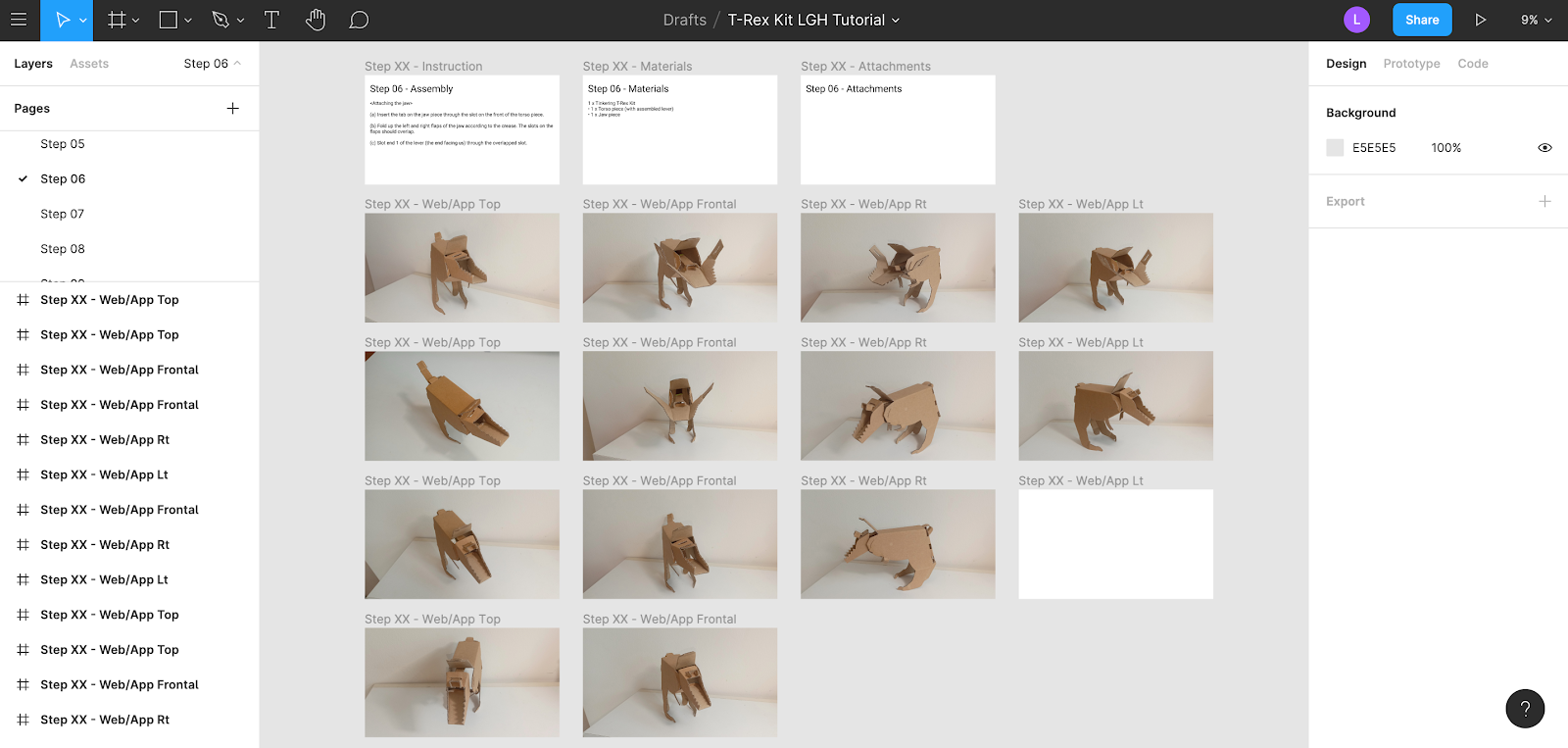
Tinkering T-Rex Kit Tutorial (Figma)
Short Story
Other than the Tinkering T-Rex Kit, I also worked on a project that I personally found very interesting — writing a short story to accompany the IoT Smart House, a beautiful two-storey dollhouse with many IoT components that Iskandar, a talented maker intern, built.
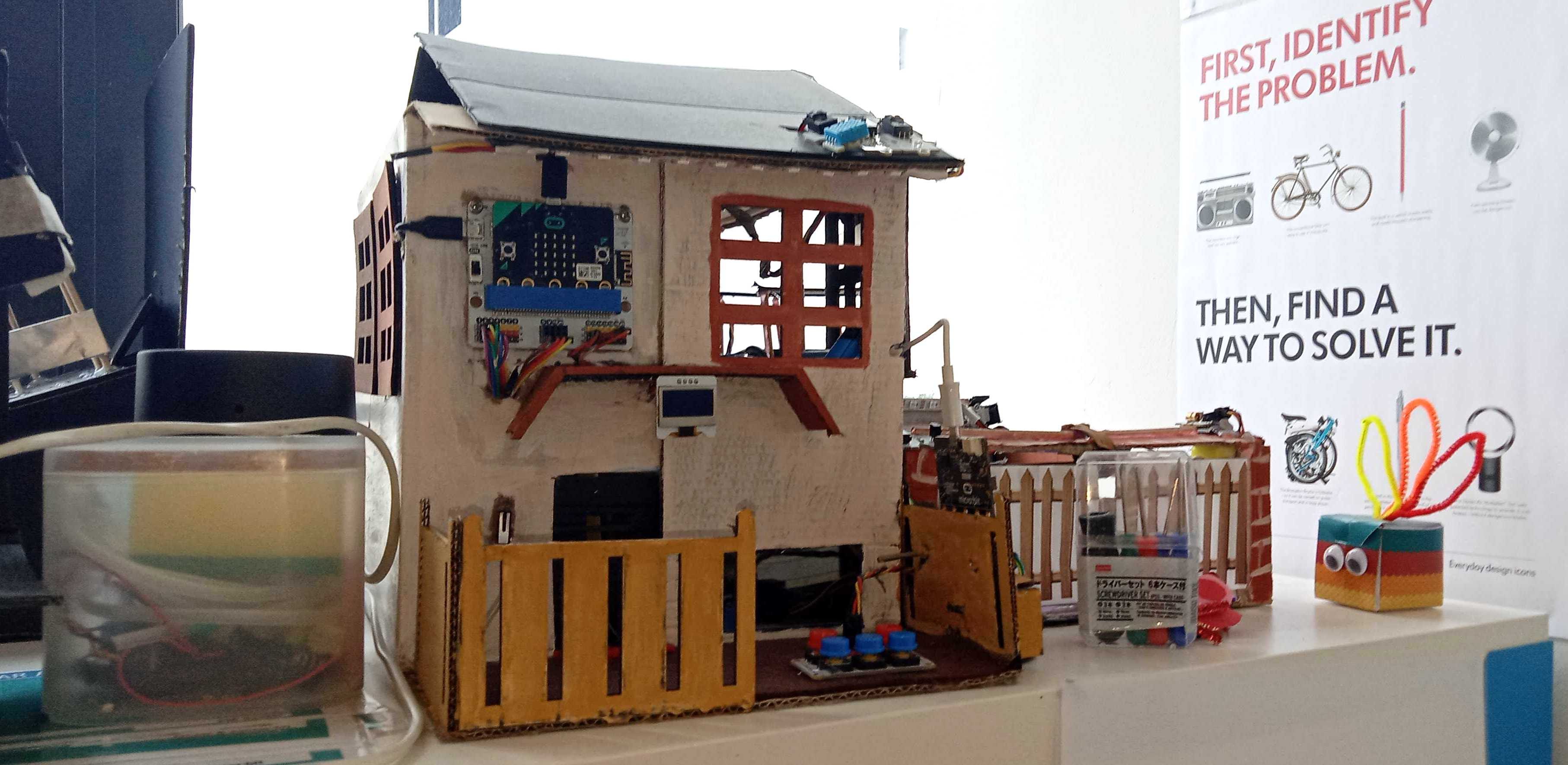
Iskandar’s amazing IoT Smart House!
This short story was part of marketing efforts, and I was tasked to incorporate all the components of the IoT Smart House into a story, based on Hetty’s creative plot idea (thank you!). As I didn’t have much prior experience writing narrative fiction, this was an interesting experience that allowed me to explore a bit more with this form of writing, and get my creative juices flowing!
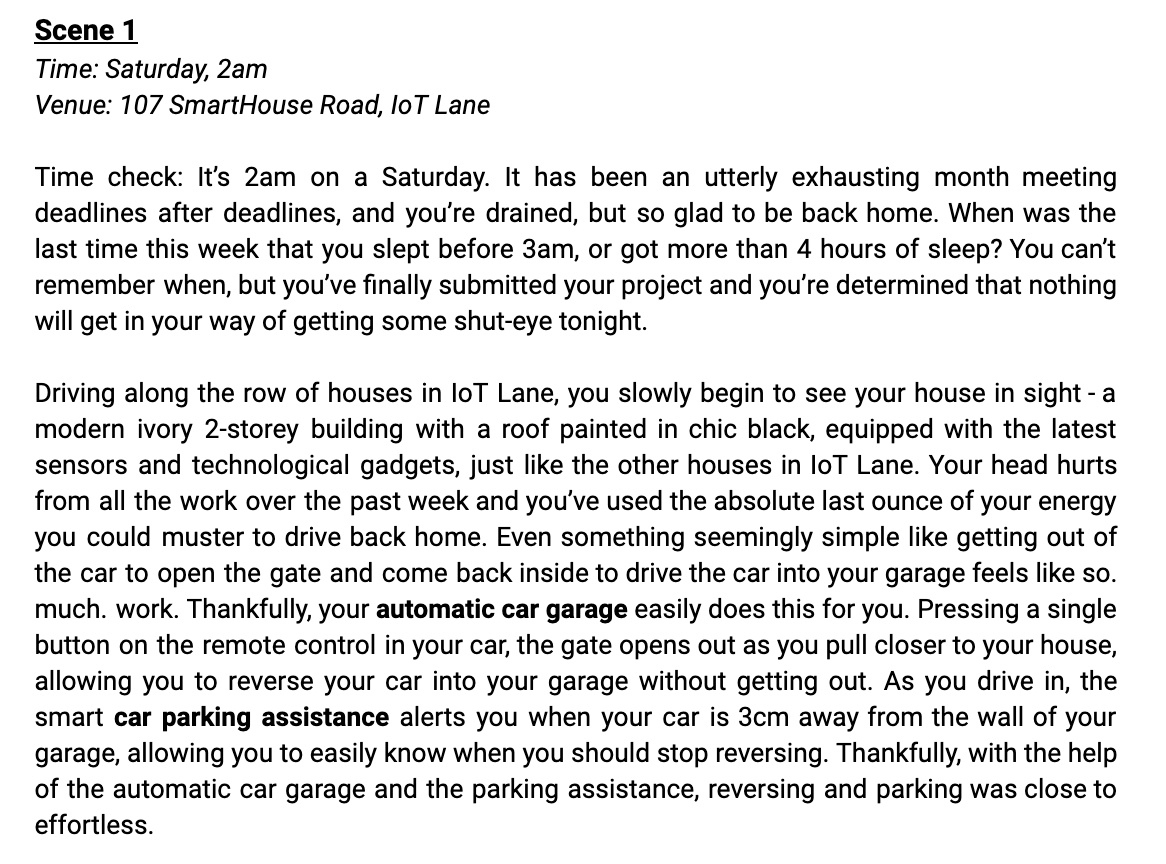
A snippet of the short story
Product Review
My involvement in the marketing efforts has been a whole bunch of new but exciting experiences, which I was not exposed to previously. Working with the Pirate Radio Kit, a product sold on the company’s online Get Hacking store, and writing a product review for it, was no exception too. Here, I stepped out of my comfort zone and got my hands on this Raspberry Pi Zero W project that involved soldering. It was quite a confusing experience as I was building it, but allowed me to exercise my problem solving skills and learn a lot about hardware. Seeing the project eventually completed and working well was also a very fulfilling experience for me, huge thanks to everyone in the office really for helping me build this project despite their busy schedules!
If you’re interested to find out more, you can read my Pirate Radio Kit review here, or head over to the Get Hacking store to purchase the Pirate Radio Kit!
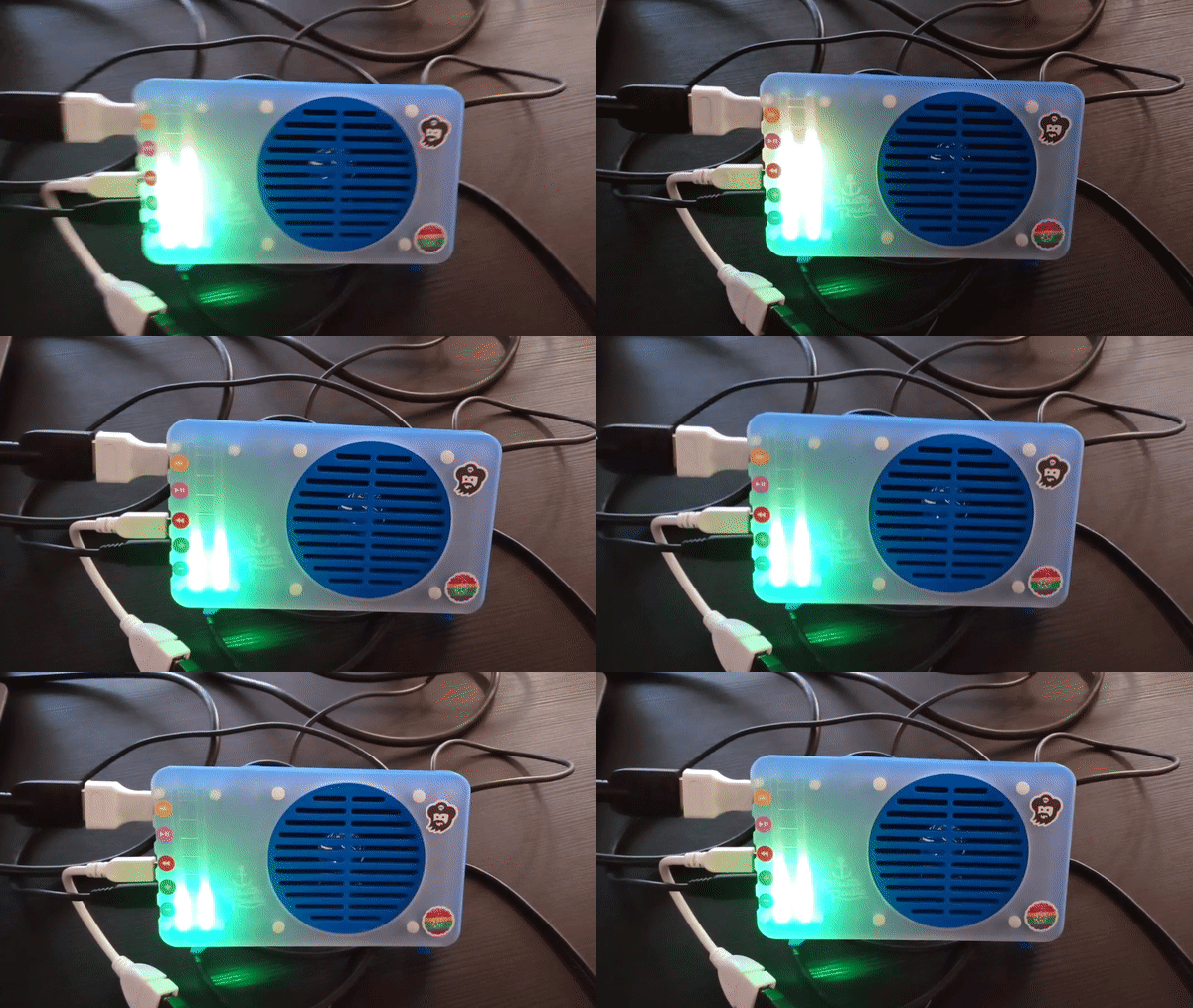
Pirate Radio Kit!

Micro:bit Book Efforts
I was involved in helping out with the company’s book efforts, where I provided feedback for the chapters, did up some code annotations on draw.io (at diagrams.net) and worked in LaTeX to make changes to the book. Being involved in the weekly book discussion meetings where I was also tasked to take minutes and summarise the key points not only allowed me to improve my summary skills (and typing speed! hahaha), but also allowed me to gain more insight into the book writing process, and recognise the amount of effort and teamwork that truly goes into completing a book and making it successful. The micro:bit guide book will be launched soon, and I will definitely keep a lookout for it!
Micro:bit Lesson Video
With the COVID-19 situation that has postponed many physical lessons, there has been an increase in the demand for virtual classes conducted online. I was involved in a video project where we filmed Mr Akmal conducting a lesson with two other interns as his students in the video, and gave some input and suggestions based on the video Hetty cut and edited. It was my first time being involved in a video filming project, and it was really cool seeing the office transformed with 4 cameras (including 1 overhead one on the 2nd floor) set up for the video!
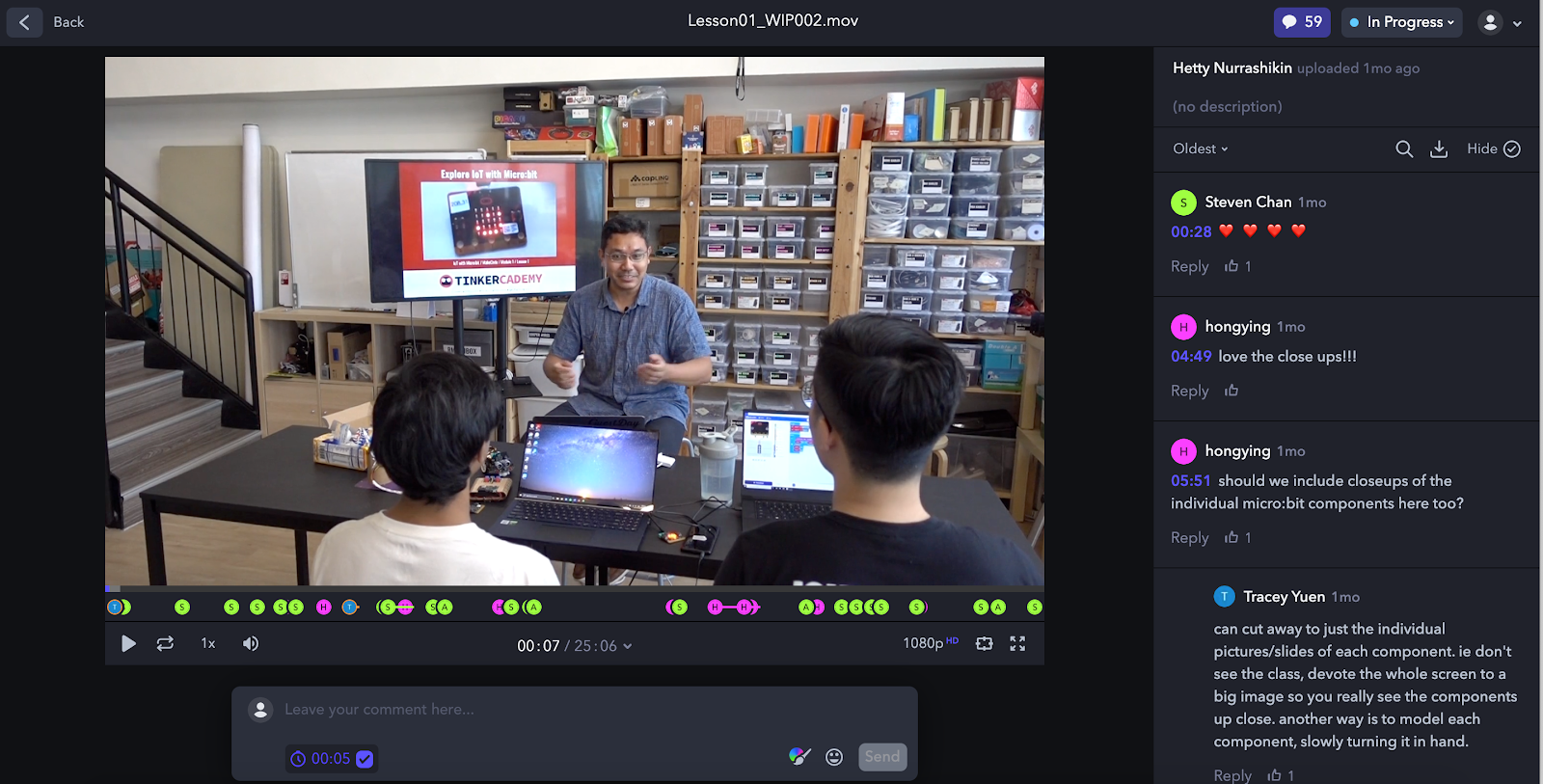
frame.io file of the video that Hetty edited
Website Research
Not long after I joined Tinkertanker, I also helped with doing some research on the websites of a few other companies providing similar services, and came up with a table comparison of the different features of each website and our new website should emulate / avoid doing. This allowed me to have a clearer sense of other companies in the industry, and the ed-tech space in Singapore.
Laser Cutting
Other than these, I would also like to share a fun project that I did! When I first joined Tinkertanker, I wasn’t initially assigned to any particular project yet. This gave me the time to explore a lot with all the equipment and resources from the office — ranging from the laser cutter, 3D printer, acrylic bender to different micro:bit parts and craft materials. With access to the whole host of equipment and resources from the office and with the help of the really friendly interns, I did up a rough vector design on Inkscape, sent it to RetinaEngrave for laser cutting on the wood and acrylic pieces placed into the laser cutter, and pieced them all together with a hot glue gun, building a tea bag holder for the office pantry. Cutting up acrylic pieces of various dimensions as the dividers allowed me to create compartments of different sizes to fit different types of tea bags and condiments. It was a really fun project to make and I am really grateful for the interns for very patiently teaching me how to use the laser cutter!
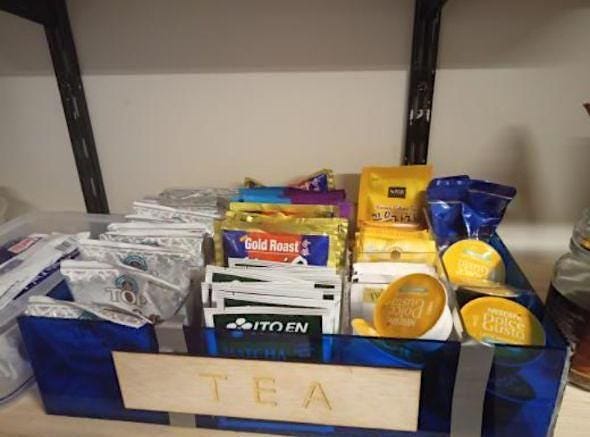
My High Tech Maker Project: A tea bag holder
This also proved useful when I had to laser cut a cat for a waving Maneki Neko waving fortune cat project, and a door for the Access Denied security door project, that sounds off whenever the door is not closed properly. The assembled acrylic pieces for the project in the picture below were all cut individually with the laser cutter!
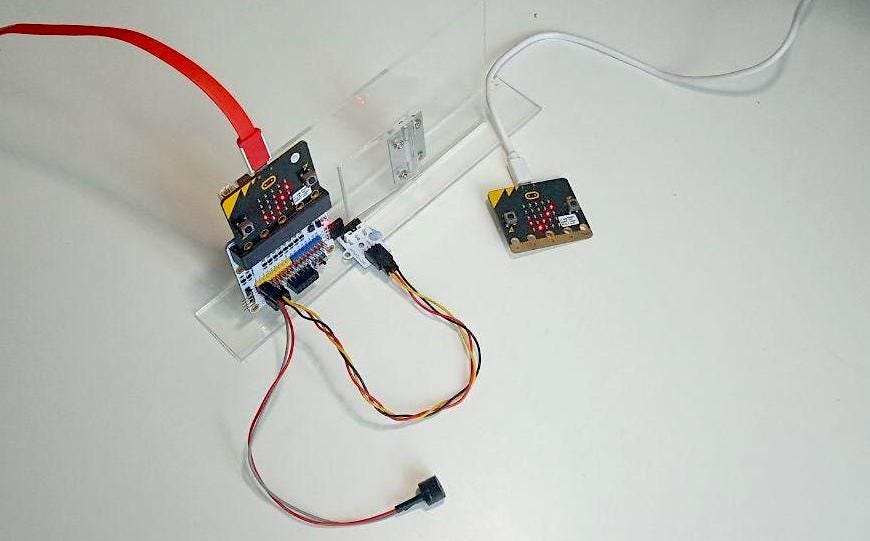
Access Denied Security Door Project
Video Project
Before leaving, I also worked on one final video project with two other interns, Jing Ting and Amelia, as part of a mini project to foster bonding among the interns during work-from-home in the current COVID-19 climate. This was a rather interesting project that also allowed me to explore with video editing, and get to know the other interns better. A huge shoutout to Jing Ting for the horror movie concept and idea! I’m not a fan of horror, but I definitely enjoyed making this video and getting a good laugh out of the “ghostly” photos we edited of ourselves.

In conclusion, my past half a year at Tinkertanker has been nothing short of an amazing and invaluable experience that I’m extremely grateful for. I was given the opportunity to be involved in a whole bunch of things — from the more technical side of things (like coding curriculum development and involvement, working with Python and micro:bit), to other more creative projects (content creation and editing for the lets.gethacking.com site and t-rex kit, video projects, product review, micro:bit book) and even fun ones like working with the laser cutter!
This has really allowed me to learn so much and put a multitude of skills to practice, deepening both my technical understanding and soft skills like marketing, content creation and even design, when I worked on the T-Rex Kit project. I am truly grateful to have been given the opportunity to have played a part in so many different areas of the business operations!
Working in many group projects such as the Tinkering T-Rex Kit and various video projects has also taught me the importance of group work and how to be a better team player — in terms of communicating clearly, setting realistic targets and working efficiently to meet the schedule, adapting to any changes along the way, and working together with other teammates towards the common goal.
Above all, I am extremely grateful for the culture and environment at this dynamic company, where everyone (staff and interns alike) is inclusive, helpful and understanding. I’ve had a lot of fun while learning and contributing here, and benefited immensely from everyone’s help. The company genuinely respects and takes into account interns’ opinions, and interns are definitely given the opportunity to play integral roles in many aspects, far beyond pure routine administrative tasks. I’ve always felt appreciated and recognised for the effort I put in, which has definitely played an important role in spurring me to do better.
Tinkertanker really prioritises the welfare of its employees, staff and interns alike, which is something I really really appreciate! If you’re interested in an internship at Tinkertanker, other than the multitude of opportunities, here are some great perks that you can look forward to as well:
- Flexible work hour arrangements, even before the whole work from home situation (but also being especially understanding about it in this COVID situation — in fact, we were given the option to work from home from as early as February!)
- Respect and consideration given to interns’ opinions alike
- Weekly game sessions
- Regular company-wide cake celebrations for birthdays and any interns who are leaving.
- Oh and, maybe even something special on Chinese New Year! Hahaha
As my internship draws to a close, I am truly grateful to everyone in the company for making the past half a year of my internship such an enjoyable one, and for being really patient helping me learn and grow a lot along the way. Thank you for the amazing internship opportunity and experience Tinkertanker! I’ll miss all these great memories for sure :’) Till we next meet!

Thank you, Tinkertanker!