

Part 2 of our journey to the Venice Biennale. Read Part 1 first to avoid spoilers.
Packing tubes
Taking:
- Blinding LEDs,
- Motion detectors,
- Micro-controllers, and
- Enough batteries to power the whole shebang
… and stuffing them into tubes as short and thin as possible shouldn’t be that hard—people who make cheap lanterns and glow-sticks do that all the time! I forget that they have the luxury of scale and perhaps a thousand man-hours of prototyping, coupled with possibly human-rights violating cheap labour.
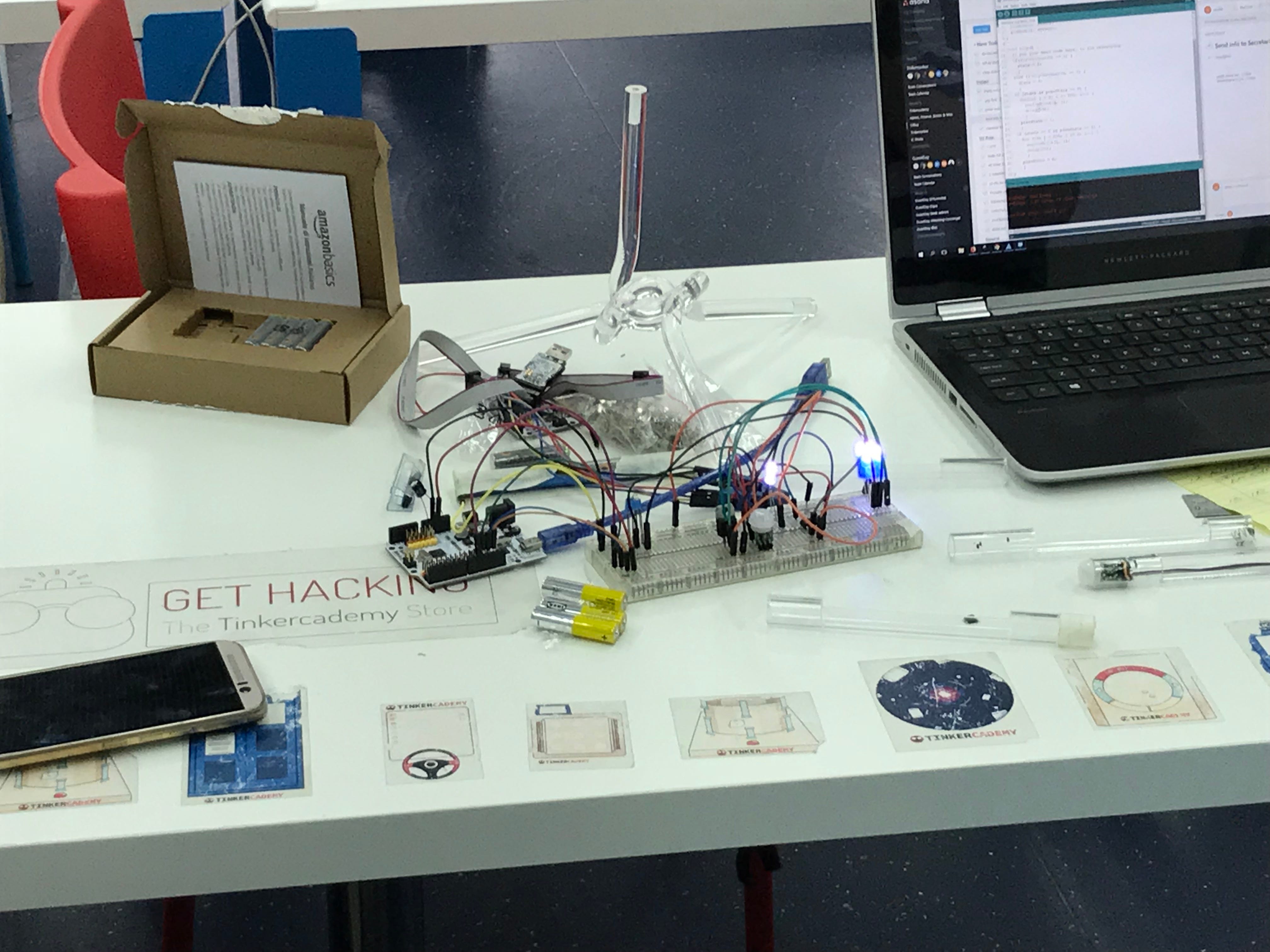
All of this into that thin tube
Thankfully, by the final iteration of the knotted cloud, we have only 80 of these motion-sensing, interactive glowing tubes to complete. This somehow lends an air of calm around prototyping and finding a possible method to manufacture them in the office.
Flexing and breaking
There are a number of options to making printed circuit boards (PCBs) — through-hole, surface-mount devices (SMDs), flexible, fibreboard. To fit a PCB inside a teeny tube with a inner diameter smaller than my thumb, the board has to be (a) tiny, or (b) squishy and compressible. The only hard fibreboard we have on hand for the circuit-printing Voltera is their regular FR6 substrates, that are so thick and large I despair at the thought of cutting them up. We do, however, store flexible ink in our fridge, because… that’s what all tech companies do?
The choice is clear: we’ll print 120 flexible circuits, and solder parts to the 80 working ones. They’ll fold and squish easily into the tubes since they’re flexible. And because it’s done by a machine, the process will be relatively automated and easy… right?
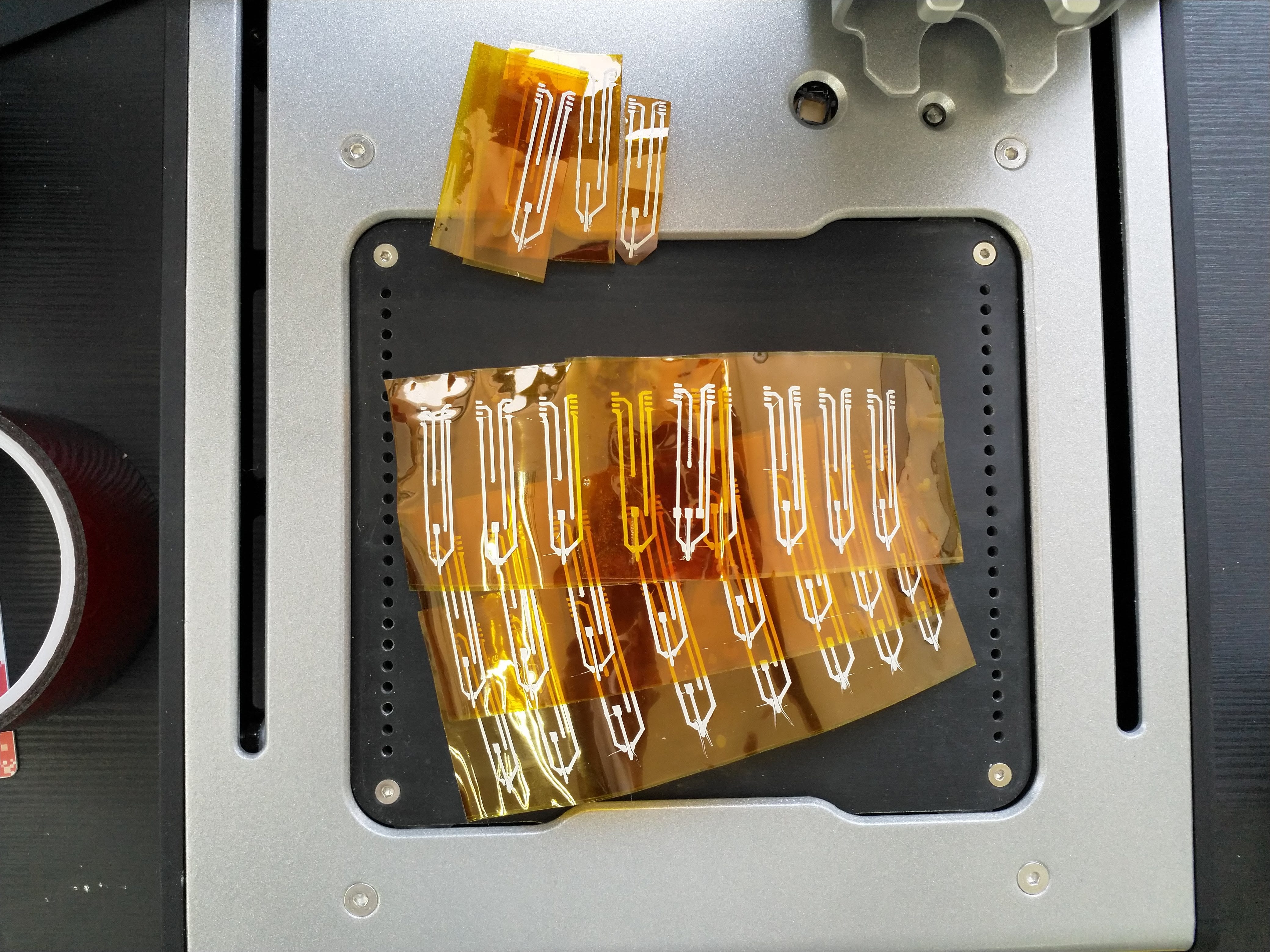
Automated enough to mass-produce these circuit prints
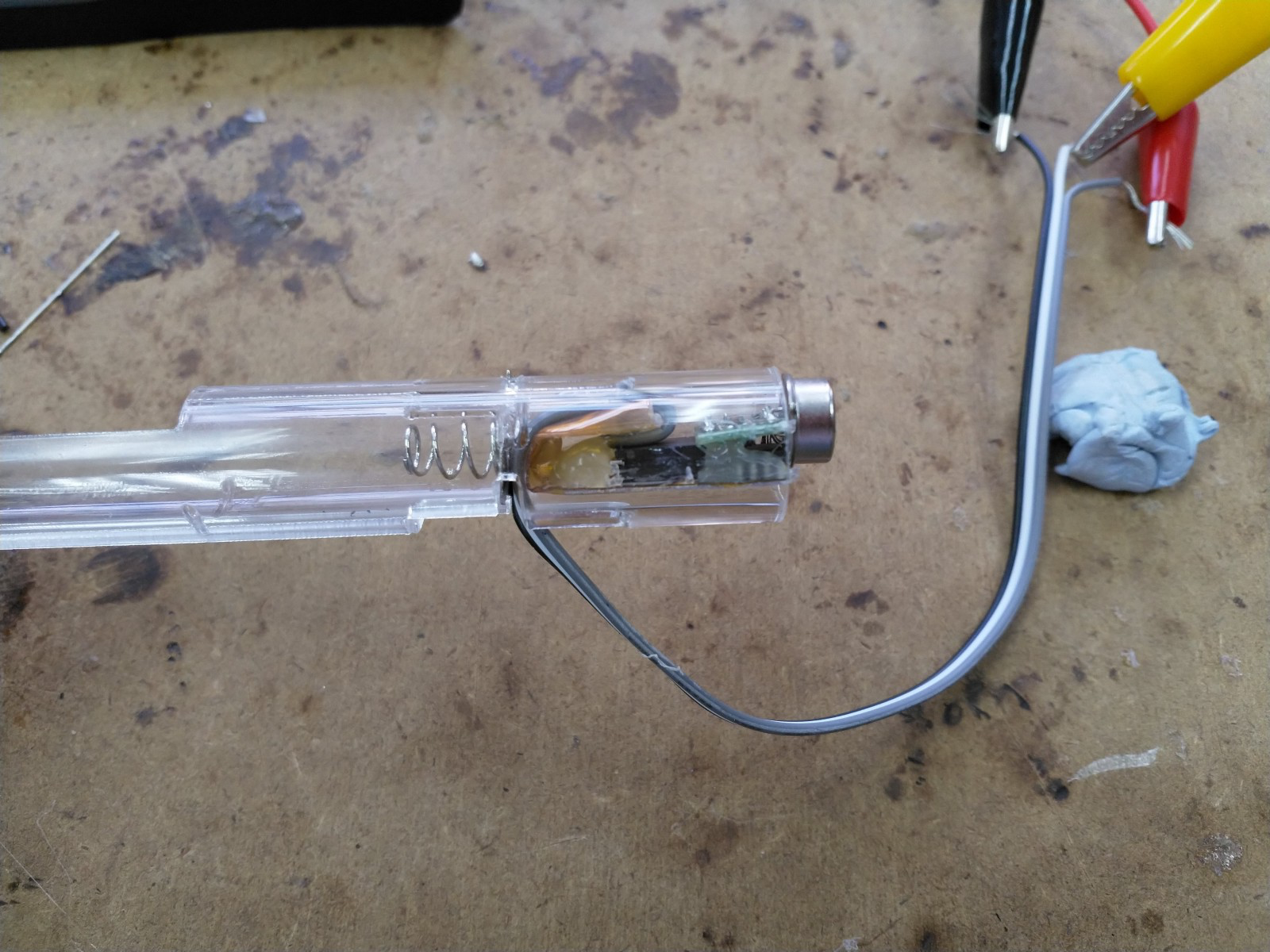
As it turns out, printing the circuits is the easy part. However:
- Making sure the solder creates a solid connection from electronic part to the circuit without breaking is one thing.
- Soldering without melting away the fragile circuit is another thing.
- Soldering SMDs in itself… is a huge thing.
Imagine trying to pin down an ant to a board by each of its legs with only two blunt chopsticks. Only, any pain-inflicting cruelty in hand-soldering SMDs is purely masochistic. I might have broken some manpower laws if I got interns to hand-solder SMDs for all 80 of the light sticks.
And yet, after all that testing, it’s entirely unreliable… we get one or two good sticks from it. The Voltera is, after all, a prototyping machine, and should really be treated as such.
In early May, after I’ve left for Venice, Steven decides to dead bug everything instead, and proceeds to solder micro-controllers straight to sensors straight to wires and battery springs. This, and roping in all the manpower available to set up a chaotic assembly line, helps get everything finished in time to be hand-carried over.
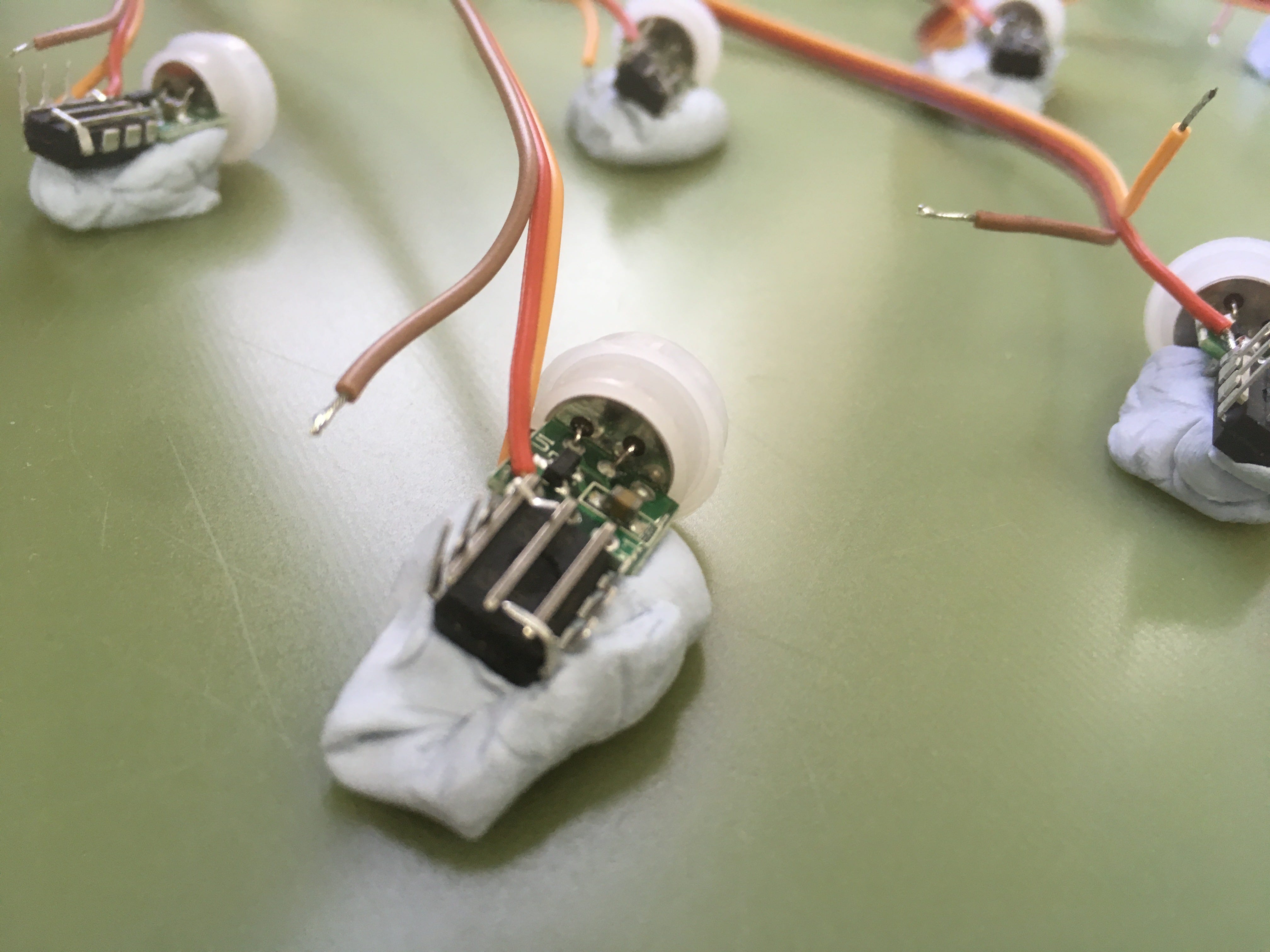
Dead bugs, live circuits
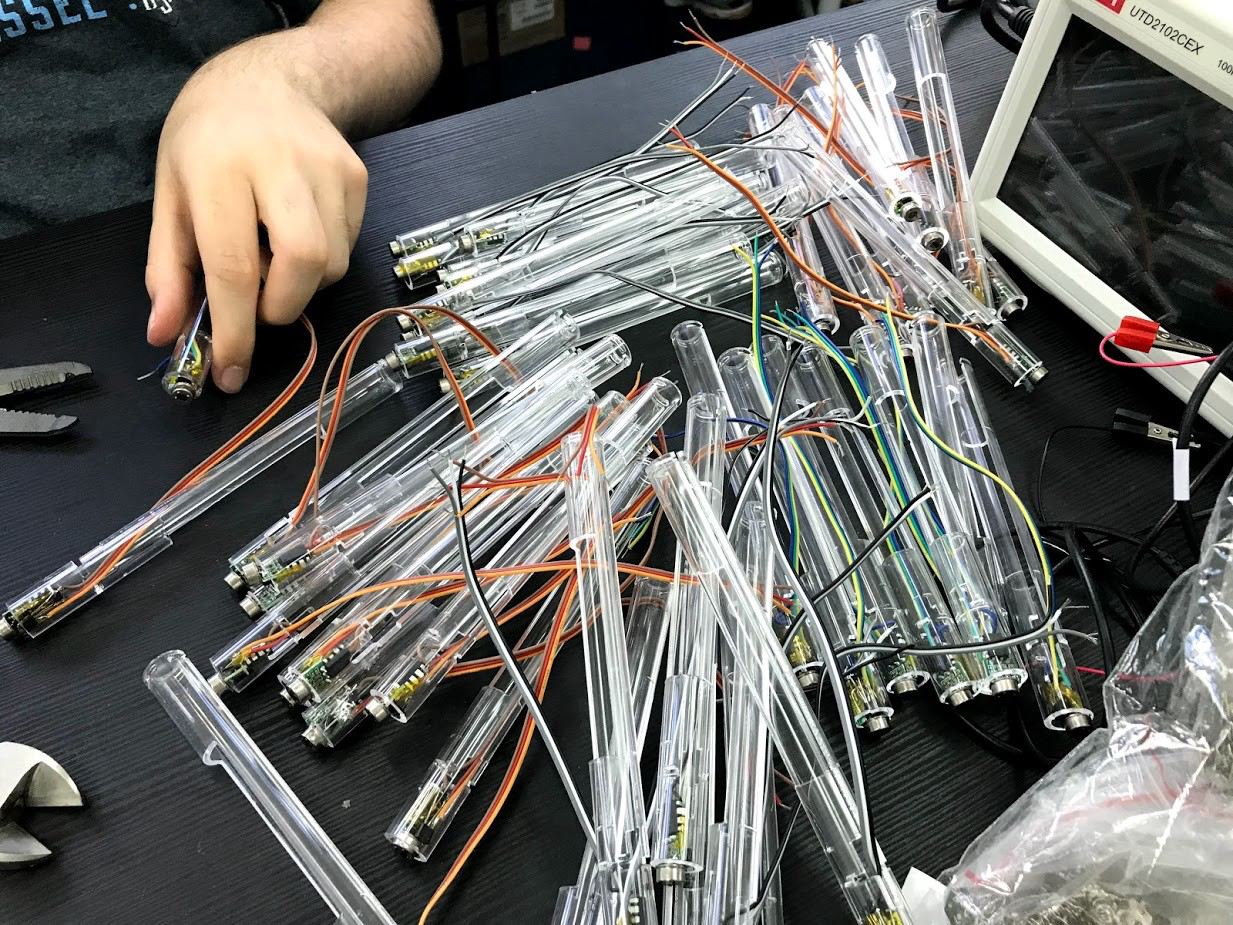
Assembly line mess
Finding housing
To house our motion detectors, we find these almost perfect acrylic tubes at Dama Trading:
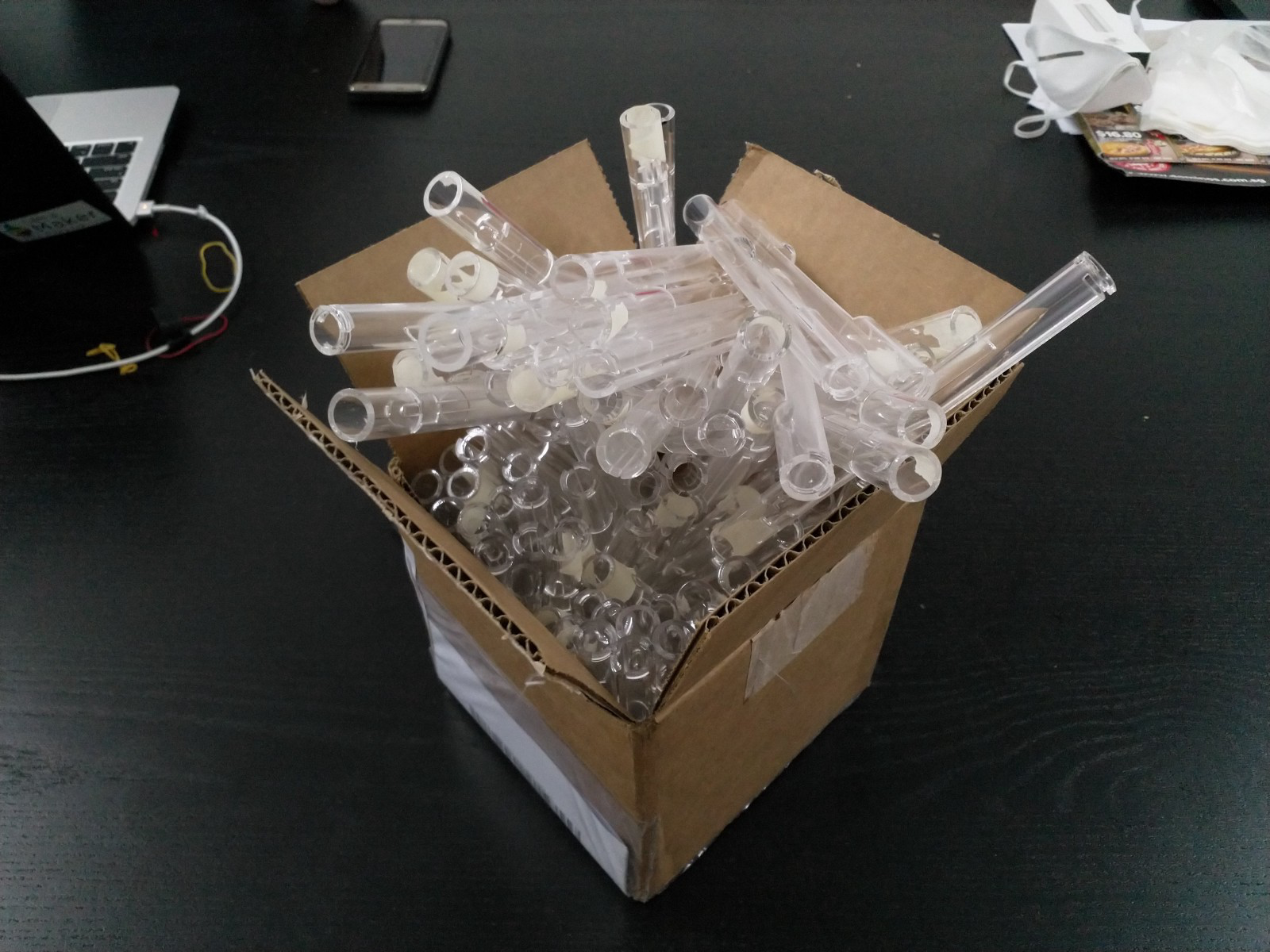
They’re only a millimetre or so off the diameters of the knots, they hold our motion detectors ever so snugly, and the batteries were made to fit the long clear plastic pipes. A match made in heaven!
However, we soon realise that the tubes can only be precisely cut through with a laser cutter… and our hobby machine is no match for such an acutely curved surface. Without the laser cutter, I can only imagine chopping them crudely in half. I consider the prospects of half-acrylic tube, half-cloth chimeras, held together by copious amounts of glue.
Thankfully, the rotary attachment Steven ordered (to laser-engrave rolling pins and beer bottles) arrives fortuitously on time—just a couple weeks before I fly! It’s put straight to work, slicing apart acrylic tubes that will be hand-carried to Venice.
Battery change challenges
Another of the design challenges is to ensure that it would be an easy task to change the batteries on these sticks. If the 4 LEDs end up using as much power as our tests show, the batteries would die in, say, two days of heavy foot traffic at the exhibit. And if every power change was a perilous task, we might be hearing of docents who pulled down the entire structure in valiant attempts to swap batteries out to charge. (At this point, the architects might be happy with things just lasting through opening night, and dying forever afterwards.)
Enter the outer sheath — a ceramic cylinder custom made to cover this ugly beast to provide some respite to the eyes (and nose). Made with Singapore soil, and sprayed with Vanda Miss Joaqium fragrance—you can’t get more patriotic than that!—it helps by letting the electronic core of the light-stick be unsightly as anything, while letting batteries become accessible from anywhere along the tube, instead of from the openings. Cue midriff cut-outs and wires galore.
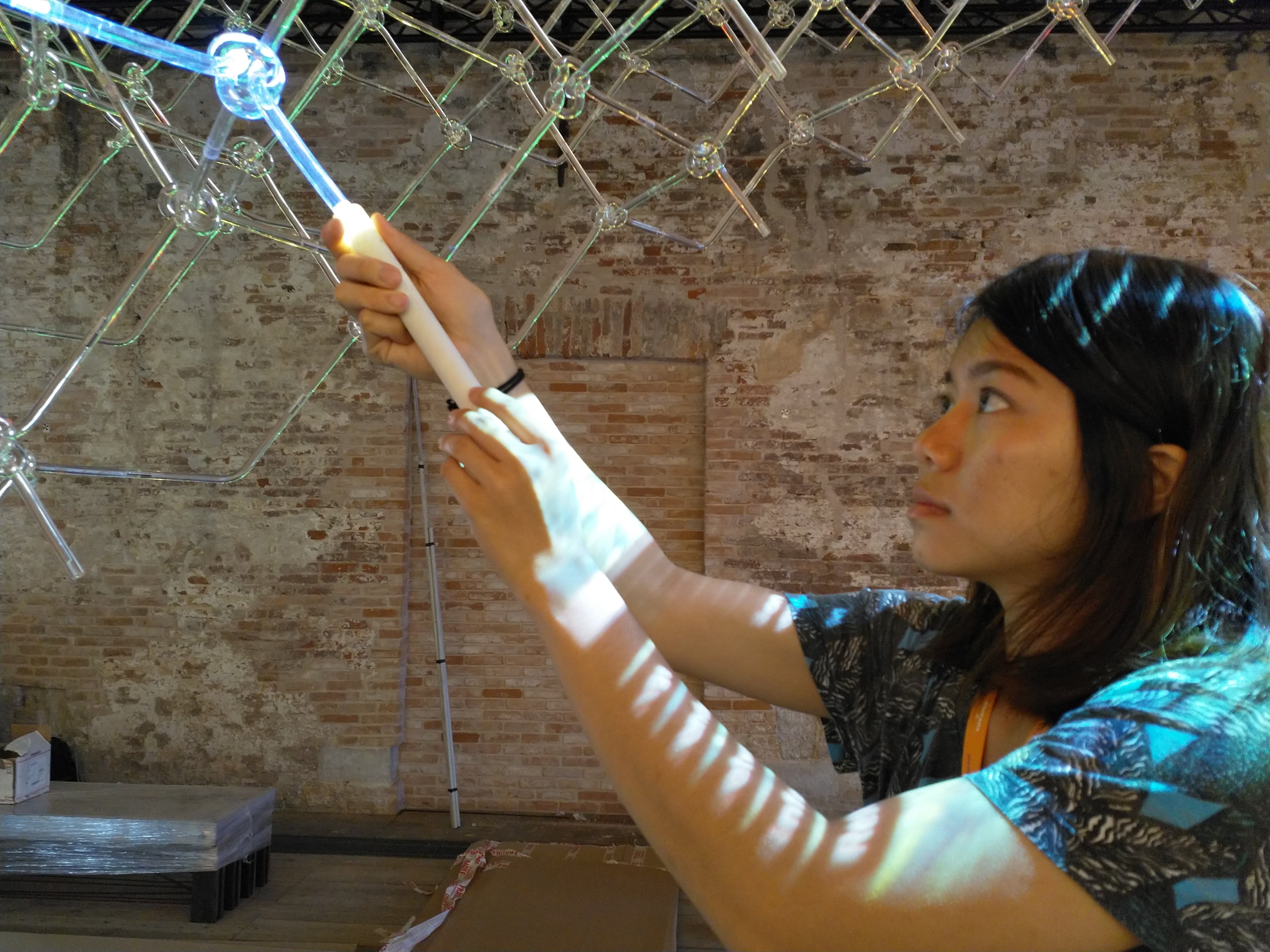
Out in the wild — Inez gingerly tries unsheathing a light stick
Gain some, lose some, learn from all
Perhaps it is not so wise to be so confident about using new technologies on a tight deadline. Yet without a pressing project, would we have the impetus to test out these new playthings? What would we do with engraved rolling pins? At least now we know the intricacies of printing flexible circuits on kapton tape, and how fun it can be.